
Unit1 Raised $20 Million to Put Avatar Concerts on a Tour Bus
A British music technology company has raised roughly 15 million pounds, about 20 million dollars, to build concert productions around digital avatars of musicians, and the pitch is not about the technology. It is about the arena.
Unit1 was founded in 2025 by Barney Wragg, who ran Andrew Lloyd Webber's entertainment group for five years from late 2011 and held senior roles at Universal Music, EMI and AEG. The round was led by Balderton Capital, the firm that backed Spotify early, with existing investor Mercuri, Paul McGuinness, who managed U2 from the late 1970s until 2013, and Gilston Music also participating. The money is structured as a mix of equity and production financing, which tells you the company is funding shows rather than building software.
The comparison everyone reaches for is ABBA Voyage. That production needed a purpose-built arena in east London, at a reported cost of around 140 million pounds, and it has not moved since it opened. Unit1's claim is that its shows travel. The company says it moved a full production between venues in four days, that its shows fit rooms under 800 seats, and that the same production can run in several countries at once. It says a show breaks even at roughly 70 percent capacity in its first year.
What actually appears on stage
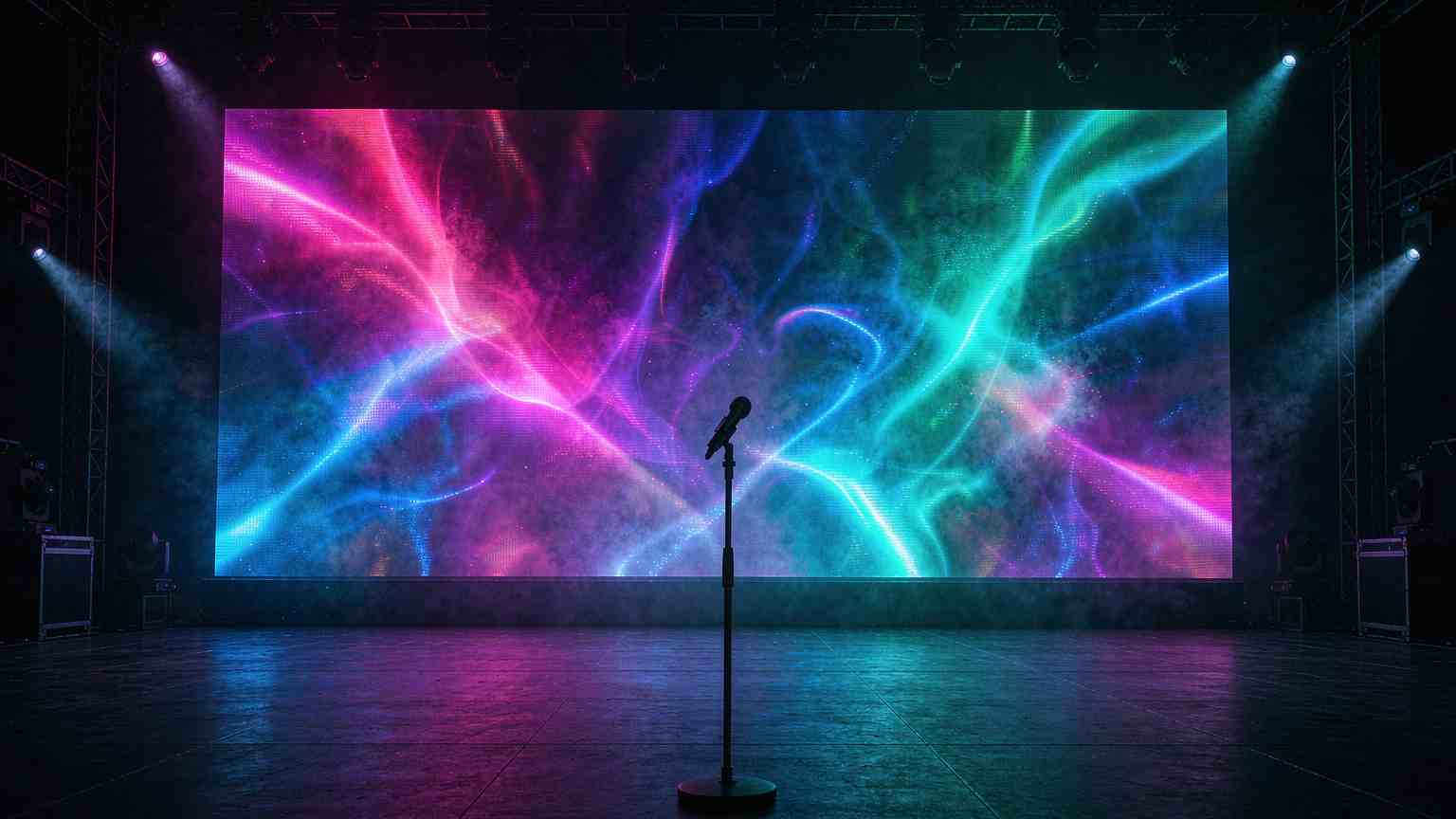
The format is not a hologram, and the industry keeps using that word because it is convenient. Unit1 synthesises three-dimensional models of a performer and displays them on high-definition LED screens, then layers live lighting, sound, props and staging around the screens to dissolve the edges. In the company's model there are also live musicians on stage beside the digital performer, so part of the music in the room is being played in the room.
The production is closer to theatre than to visual effects. Unit1 describes an end-to-end process spanning artist relations, creative direction, performance capture, CGI, staging, venue operations and financing, with partners across LED display technology, lighting, sound, media control and post-production. The illusion depends as much on sightlines, props and sound design as on the model that generated the face.

The audience still travels to a venue and sits or stands with other people. What has changed is the body at the centre. "For the audience member in the room it is seamless between the digital and the physical room, immersing them," Wragg told The Guardian. "It's a teleportation of an audience member to a time and place." Elsewhere he has been blunter: "Nothing is 'real.'"
The only performer Unit1 has demonstrated publicly is KT Tunstall, who acts as an ambassador for the company. Motion capture cameras recorded her recreating a performance from roughly twenty years earlier on Later... with Jools Holland, and the avatar was updated to show her as she looks now. That is the technically easy version of the problem, because the artist is alive, willing and in the room.
The hard part is permission
For a deceased performer, the pipeline changes. Unit1 says it builds a digital double from archive footage together with actors and musicians who resemble or can perform like the artist, and blends the material. Wragg has named Queen at Live Aid, the Beatles at the Cavern Club and Jimi Hendrix at Woodstock as performances he wishes he could have seen, which is also a fair description of the catalogue he is shopping for.
The ethics are not hypothetical. Earlier in 2026 a plan to build an AI-powered avatar of the late Black Sabbath frontman Ozzy Osbourne drew a backlash from fans who found it disrespectful. More than eighty performers, including Matt Lucas and Hugh Bonneville, have asked the UK government to legislate protection for voices against AI cloning. Wragg's answer is procedural: the company works with families and estates, and it sticks to concerts that are extremely well documented, adding that it is mindful of not being distasteful.
The questions that remain reach past taste. Who signs off a deceased artist's movements, voice and stage dialogue? Does a recreation preserve a performance that happened, or invent one that did not? And how clearly should an audience be told which parts of the evening are live, which are recorded, which are reconstructed and which are generated?
There is also a labour version of the objection, and it is the one that will not go away. An avatar does not need a union, does not need health insurance and does not age. A show that can run in several countries at once removes the touring work that a human band would otherwise be paid for, and the people who would have been paid are the ones being asked to bless it.
Why the ABBA number is the whole argument
The economics Unit1 is attacking are visible in one comparison. ABBA Voyage required a venue built for it, which means the production is permanently attached to a building and its development cost is amortised across one room. A touring version of the same illusion spreads that cost across every venue that takes it and every country it plays in at once. A human band cannot be in two cities on the same night. A digital performer can, provided the staging is portable enough to install in a venue that already exists.
Wragg's four-day relocation claim is the load-bearing one. A production that needs weeks to move collapses back toward a residency, at which point the model is ABBA Voyage with a smaller budget. A production that moves in four days behaves like a tour, and the venue becomes a rental rather than a capital project. That is the difference between a novelty and a business, and it is the claim the first few ticketed shows will either confirm or end up disproving.
The business model is the argument
Unit1's commercial structure differs from the earlier avatar ventures in one respect that matters to artists. Rather than buying a catalogue outright, as Pophouse did with KISS before launching an avatar show, Unit1 says artists and catalogue owners receive higher royalties and keep their rights. That positions the company as a venue and production partner rather than a rights aggregator.
It also explains why the funding is partly production financing. Each show is funded as its own production, which means the company needs permission before it needs compute. The catalogues worth the most are the ones with the most protective estates.
Two decades after Tupac appeared at Coachella as a projection, and four years after ABBA proved audiences will pay for a younger digital version of a living band, the technology is no longer the constraint. The constraint is a signature on a licensing agreement. Unit1's twenty million dollars is a bet that enough estates will provide one, and that enough venues will take a show that does not require an arena built for it.
Related articles
China Started Writing Rules for Agent Identity, and the Question Is Who the Agent Works For
Identity is the easy half. The difficult half is attribution.
Anthropic Will Now Bill You for a Request It Refuses to Answer
A blocked request that costs nothing is a free probe.
China Put a Huangmei Opera on a Vertical Screen, and the Singing Survived
Either the model was trained on the real thing or the output sounds wrong to the only audience that would notice.
13,000 Internal Screenshots Ended Up on Public GitHub, and No Attacker Put Them There
A default behaviour, repeated across a fleet, is a policy outcome.