
The Art Community’s “AI-Detection” Battle: Both Sides of Commissions Are Forced to Prove Themselves, and AI “Image Blending” Pushes Trust to Collapse
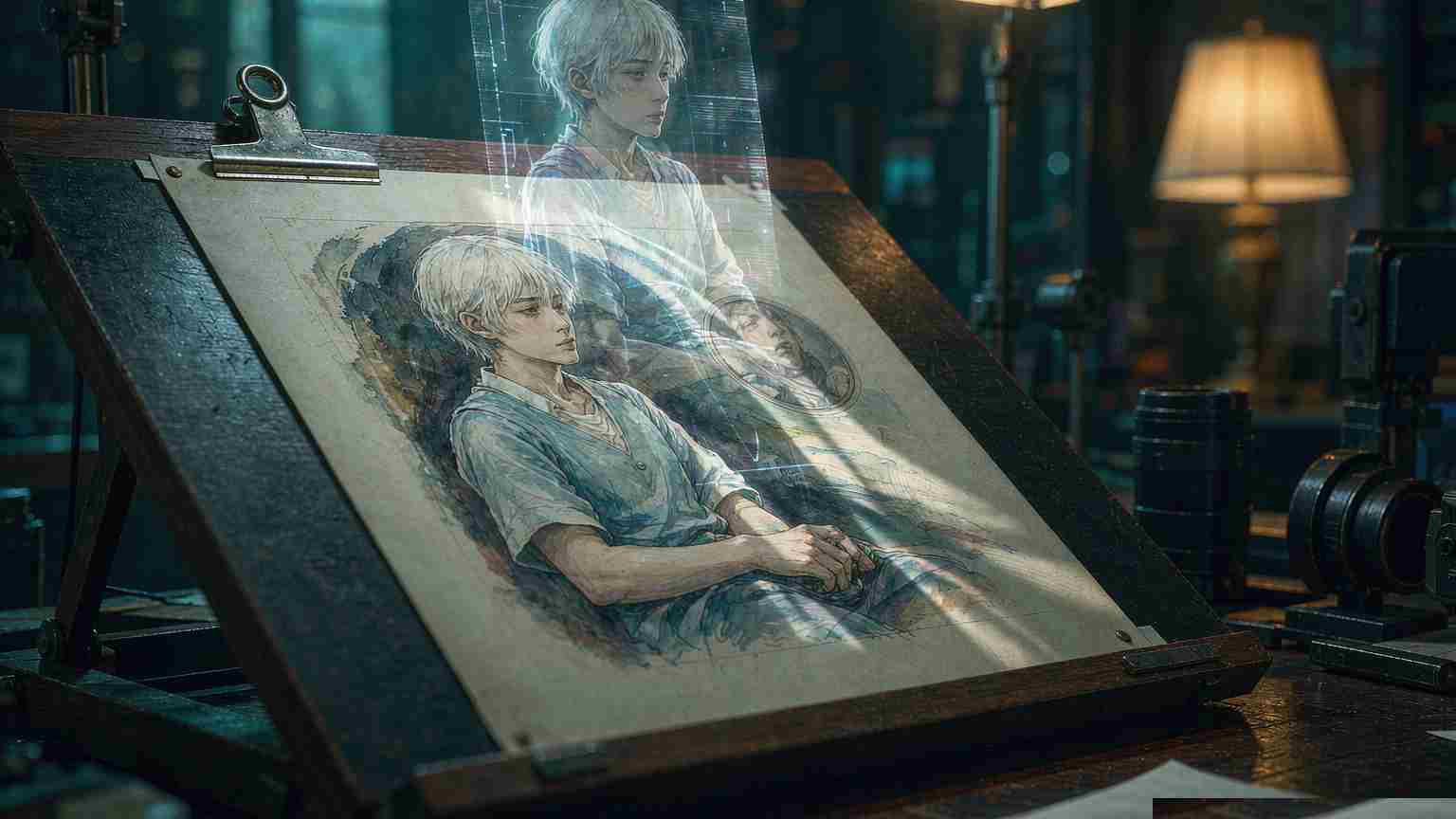
On the evening of September 15, an illustrator in Guangdong posted a video just over two minutes long titled “What Should a Small Illustrator Do When They Receive a Suspected AI-Generated Character Design?” The premise was delicately framed: even the commissioner was not sure whether the OC design image in their hands had been generated by AI. The creator had originally intended it only for a small circle, but the video ended up with 23,000 likes and more than 600 reposts. The next day, a post from the commissioner’s perspective appeared, titled “What Should I Do When the Illustrator Implies My OC Is an AI Design?” It received more than 2,500 likes, and the original poster’s approach—“don’t argue, prevent escalation, preserve evidence”—was treated by the comments section as a template.
Both sides feel they are the victims, and both may be right. This is the most authentic cross-section of the recent AI-detection wars in the art community.
Sharpened at Both Ends: Those Who Paid Fear Buying AI, Those Who Draw by Hand Fear Being Taken for AI
First, the commissioner’s side. On August 1, someone on Weibo exposed a finished image with an “AI-generated” watermark still plainly on it—not even removed. On August 24, someone browsing the commission platform Linjie came across an illustrator who was clearly tracing AI, and posted, “Is this teacher AI?” The post got more than 3,900 likes and over 1,500 comments. On August 26, a Xiaohongshu post titled “Paid 200 for a Commission and Got AI, Then the Illustrator Ran Off”—a 200-yuan piece—received 10,000 likes and 2,088 comments, with the comments section full of “I’ve run into this too.” On September 19, even Huajia, a commission platform that emphasizes vetting, was reported to have a newly joined illustrator who appeared to be an outsider using AI.
Now the illustrator’s side. In August 2025, a Bilibili video titled “Hand-Drawn from Scratch, but Identified as AI” got 730,000 views and 69,000 likes. In April 2026, after the “Trapped in Eternal Night” project was questioned, it issued a statement in hard terms: “This artwork was independently and originally hand-drawn by the collaborating illustrator throughout, with no AI tools involved at any stage.” It received more than 2,500 likes. On August 24, another Bilibili video appeared: “Do Illustrators Whose Art Was AI-Blended Still Have to Be Called AI?”
In the same case, the side paying fears they bought a machine-made image, while the side drawing fears their hand-drawn work will be misjudged. The anxiety on both sides points to the same thing: detection itself is unreliable.
“Image Blending” Is Not a Legal Concept, but What It Describes Is Real
In the industry, AI “image blending” is not a strict legal term. It usually refers to: an original work being input into a generative AI without permission, and the new image generated being highly similar to the original in composition, characters, elements, or overall art style; or the work being used to train a model, after which the model continuously produces content bearing the original artist’s characteristics.
In mid-September, Long Zijia, founder of the jewelry design brand CIGALONG, posted a rights-protection video. He said his original work “Dream Garden · A Dream of Four Seasons” had been “AI-blended” by a company: from design composition and post-production layout to the model’s “face blending” and font style, the AI-generated images involved were almost completely identical to the original work. He revealed that before he posted the video, the head of the company involved had already apologized via private message, and the related “AI-blended” content had been deleted in large batches.
In a September 30 report by The Paper, illustrator Hua Zhangsan’s experience was more specific. She painted a cover for a publisher’s Dunhuang-themed book; the main subject was a pair of a young person’s eyes gazing at Dunhuang murals. Conception took several days, and the hand-drawing took another four or five days. Later she saw a highly similar image, in which “two people had appeared out of nowhere” in the eyes. The elements corresponded to one another, but the rendering of details was inconsistent, and there was an obvious collage-like feel between the eyes and the added figures. She said she had “a lot of question marks.”
Another illustrator, Yin Ti’an, is a fan artist for the Genshin Impact character Scaramouche and has drawn several hundred pieces over more than two years. During the 2024 Spring Festival, she posted a celebratory illustration. Within two days, several fans sent her the same short video link, asking whether she had authorized it. In the video, the character’s pose, position, and prop in hand were the same as in her illustration, except that it had been processed into a different cartoon-rendering style.
The common thread in these cases is that the illustrator first has to prove to themselves: is this image in front of them a coincidental similarity, or the result of image blending?
The Hard Part of Infringement Judgment: What the AI Did to the Original Work
In a September 18 report by China Intellectual Property News, Zhu Xiaoyu, a lawyer at Beijing Feipu Law Firm, broke this type of issue into two layers. To judge whether infringement has occurred, the key is to look at what the AI tool did to the prior work, and what relationship the generated content has to the prior work.
If the AI modifies or adds to the original work but does not produce a form of expression different from the original work, and at the same time is highly unlikely to credit the original author or indicate the source, then it infringes the right of modification and the right of attribution, both of which are moral rights of authorship. If the modification reaches the level of distortion or mutilation, it also touches on the right to protect the integrity of the work. If the generated content produces a form of expression different from the original work—for example, adapting an image into a video—then it is a matter of the right of adaptation.
Infringement risk is not limited to the generation stage. Once content enters circulation, different modes of use further implicate the rights of reproduction, distribution, exhibition, broadcasting, and communication through information networks. Even when all are unauthorized, uploading to a platform, reproducing for distribution, and publicly displaying in an exhibition infringe different rights.
The problem is that all these judgments rest on the premise of “being able to prove it.” Once an artist’s work is pulled into a model, what often remains is just an image that looks very similar, and a generation record whose process cannot be clearly explained.
The Courts Are Also Pulling in Different Directions
In the same type of case, judgments are not consistent. In the “Spring Breeze Brings Tenderness” case heard by the Beijing Internet Court, the plaintiff used Stable Diffusion and more than 150 rounds of prompt iteration to generate a character image. The court found that their aesthetic choices and individual judgment constituted originality, that the image in question was a work of fine art, and that the defendant’s removal of the watermark and use of it constituted infringement, awarding 500 yuan in damages. In the “Butterfly Chair” case at the Zhangjiagang People’s Court, the plaintiff used AI to generate an image of a butterfly chair. The court held that the first input of a prompt was enough to generate a graphic embodying the thematic elements, and the plaintiff could not provide original records such as a creation flow chart, nor reproduce a completely identical result using the same prompt. It found that the plaintiff had not made personalized choices reflecting originality and dismissed all claims.
The two cases had highly similar facts but opposite conclusions. Together they put “process evidence” at the core of AI copyright determination, and conversely drew the boundary of protection: prompts alone are not enough; you have to be able to produce iteration records.
Meanwhile, platform user agreements generally state that “copyright in user-generated content belongs to the user; the platform does not claim ownership and bears no liability related to copyright,” leaving the risk of disputes to users. Doubao and Jimeng AI even add a vague clause: “if the output contains content originally owned as intellectual property by the platform, the rights still belong to the platform.” The chain of responsibility squeezed between original creators, AI users, and platforms has not yet been fully clarified by any judgment.
Data from the Beijing Internet Court show that as of July 2026, the court had accepted more than 280,000 cases of various types and concluded more than 270,000, with AI-related cases growing significantly.
The Trust Problem Arrives Earlier Than the Legal Problem
The law is slowly filling in the rules, but trust in the art community has already been depleted first. Commissioning is a small business built on personal reputation—a few hundred yuan per order, resting on the sentence “I drew this.” When that sentence starts requiring proof, requiring a recorded process, requiring self-certification of innocence before delivery, the default premise of the transaction changes.
In one illustrator’s comments section, a line was upvoted to the top: If every order requires screen recording first to prove you didn’t cheat, then this business is already impossible to continue.
Related articles
Japan Put 101.6 Trillion Yen Behind AI. The Concrete Part Is a Data Center Near Tokyo
A power company is the anchor. JERA generates electricity, and its role means the first problem is solved at the generation layer.
Broadcom Will Lend Anthropic Up to $42 Billion to Rent Broadcom's Own Chips
A hardware vendor is lending its customer the money to rent hardware from the same vendor.
Tencent Leased 100,000 AI Chips From Oracle. The Interesting Part Is the Route.
The chips did not move. That is why this deal is harder to answer than a shipment caught at a port.
China Started Writing Rules for Agent Identity, and the Question Is Who the Agent Works For
Identity is the easy half. The difficult half is attribution.