
6,162 Chinese Reference Entries, Split Into Three Cards: Person, Outfit, Pose
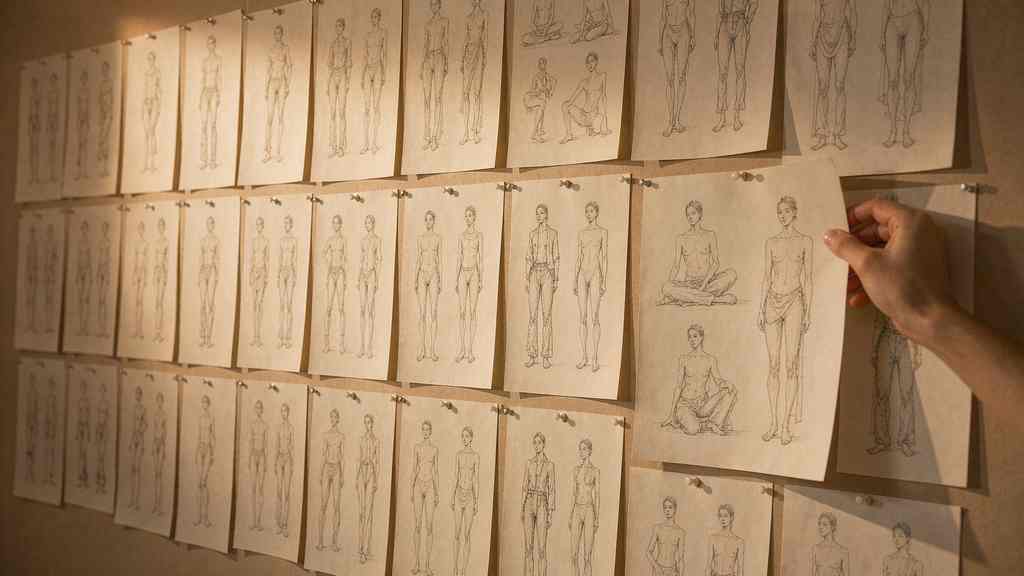
Here is the conclusion up front: this repository did not take off because it holds a lot of pictures. Plenty of cloud drives hold a lot of pictures, and nobody writes a README about them. It took off because it takes the single act of choosing a reference image and splits it into three parts that can be swapped independently — the person, the clothes, the pose — then lets you assemble those three into a recipe you can hand straight to a model. That is a different kind of product from a folder full of JPEGs, and the difference is the whole story.
The repo is called ai-pose-gallery-zh, and the author is Anhao. The first paragraph of the README does the accounting plainly: 1439 base body mannequins, each paired with a depth map, so 1439 depth maps alongside them; 3224 outfits; 1499 portrait subjects. That adds up to 6162 Chinese-language reference entries, 12022 local high-resolution images, plus another 1760 reference images that still live on the source sites. None of it was shot by the author. The data mirrors three publicly available galleries: the pose and outfit originals come from ギア (@giaaibusi), and 440 anime outfits come from たき AI's CharaDB. What this project actually did was translate, merge, and build a tooling layer on top.
What it actually fixes is retrieval, not image quality
Anyone who has used a reference library knows the sticking point. You want the model leaning against a wall, hands in pockets, body turned at forty-five degrees. The image is in your head, quite specific. But browsing the library means scrolling thumbnails a page at a time, and twenty pages in you find something seventy percent right — and you still have to describe it yourself in words. The original site's metadata is in Japanese: motion categories, hair subdivisions, garment styles, all of it Japanese tags. Chinese users either cannot read them, or can read them and still cannot assemble a prompt out of the pieces.
This repository translates all 6162 metadata records into Chinese and breaks them down to a granularity that can be assembled automatically — hair length, 51 sub-categories of hairstyle, pose classification, outfit tags. It claims the prompts you build this way come out clean, with no Japanese left in them. That sounds like marketing copy, and it may well be, but for image generation it points at a real problem: a model's output gets noticeably less stable when a prompt mixes two languages.
The three-in-one is the point, not the length of the feature list
Its Web Studio asks you to pick one item from each of three libraries: a portrait, an outfit, a pose. Base mannequin and depth map toggle with a single click. Once you have chosen, you can also drag in, paste, or URL your own reference images to mix with the stock ones. Recipes are stored in IndexedDB, so they are still sitting there after you close the browser and come back the next morning. None of that interaction is novel on its own. What is novel is that it turns a reference image from a single file into structured input.
Then there are the five direct connections: Google Gemini, OpenAI GPT Image, Alibaba Cloud Bailian's Qwen, Volcano Ark's Doubao, and a local ComfyUI. The first four run as soon as you paste in a key. The fifth needs a GPU in your own machine. The project did not build a model of its own and has no plans to. Its bet is that same recipe, different model, run it again will become routine rather than a stunt.
The ComfyUI plugin is the more useful half
The repository is itself a ComfyUI plugin. git clone it into custom_nodes/ and it works. Four nodes: pose, outfit, portrait, and the three-in-one recipe. The pose and recipe nodes carry a built-in use_depth switch that wires straight into ControlNet Depth. Whoever designed this understands the user: the mannequin gives you structure, the depth map gives you spatial relationships, and which one earns its place at render time depends on whether you need the gesture to be accurate or the perspective to be accurate.
What I like better is that the 6162 records became a visual picker that opens in a popup. Click it open on the ComfyUI canvas, choose what you want, go back and wire it up. Compared with digging through folders and dragging a file into a node by hand, that saves more than a little time over a working day.
Three boundaries worth stating clearly
First, the project does not hold the rights to the material. The pose, outfit and portrait images come from the original authors' public sites; the repository is only a Chinese-language index and an engineering archive, and the README states plainly that repackaging and reselling are prohibited. If you want commercial use, you have to go back to the original authors' terms and read them yourself.
Second, the library includes 18+ anatomical mannequins and lingerie references, with SFW safe mode on by default. This is not a small matter, and the author puts it right after the first line of the disclaimer rather than burying it in fine print at the bottom.
Third, and most important: it repeatedly emphasizes that unauthorized face-swapping of real people is prohibited. That caution has an obvious reason behind it. A library that separates portrait, outfit and pose this cleanly is, by construction, upstream of a face-swap pipeline. The tool is neutral. The use is not, and the person holding it is the variable.
Why projects like this keep appearing
Over the past year the barrier to generating an image has moved down a level, from can you write a prompt to do you have a good reference. The model side has been cooperating with that shift. Newer models like Seedream 5.5 now output layered assets with a native alpha channel, and GPT Image 2.6 pushed marked regional editing down into the API. Both of those reduce the rework that used to happen after generation. When generation gets cheaper and more stable, what becomes scarce is the ability to organize the input side.
That is where the real significance of 6162 references sits. It is not a gallery. It is a way of translating I want that feeling into a three-part coordinate a machine can execute. You could say it merely reorganized three Japanese documents into Chinese, and technically that is what happened. But the reorganizing is exactly where most people get stuck, and doing it once for everyone is a genuine piece of work.
If you just want to try it, open the online demo; it works on a phone too. If you want to wire it into production, settle two questions first: how far your material licensing actually reaches, and who you plan to hand this recipe to. The first decides whether you can sell the output. The second decides whether you get a letter from a lawyer at some ungodly hour.
Related articles
Chinese text in video always turns to mush. Dreamina handed the typesetting to code
Dreamina launched Motion Studio on November 10. It no longer generates frames; the model writes code that lays out text, shapes and pacing. Chinese titles stop blurring, but whether the content is right is still on you.
A community spreadsheet of taps that turns off the ads inside Chinese Android builds
A no-root tool that switches off the ads Chinese phone makers ship inside the system UI. Its method is a hand-written tap script per phone model, maintained by volunteers every time a ROM moves. It works, and the maintenance is the point.
GPT Image 2.6 held the token price and raised the bill
GPT Image 2.6 kept every token rate from 2.5 and still costs more per image, because more of the work now happens in output tokens. Eleven days into the ramp, the pricing structure says more than the leaderboard does.
Someone rebuilt IDM from the outside and wrote down what they did not touch
A Rust reimplementation of Internet Download Manager claims 5x the speed and 86 languages. The more interesting document is the paragraph explaining how it was built without copying anything.