
Your GeForce Runs AI at Half Speed on Purpose
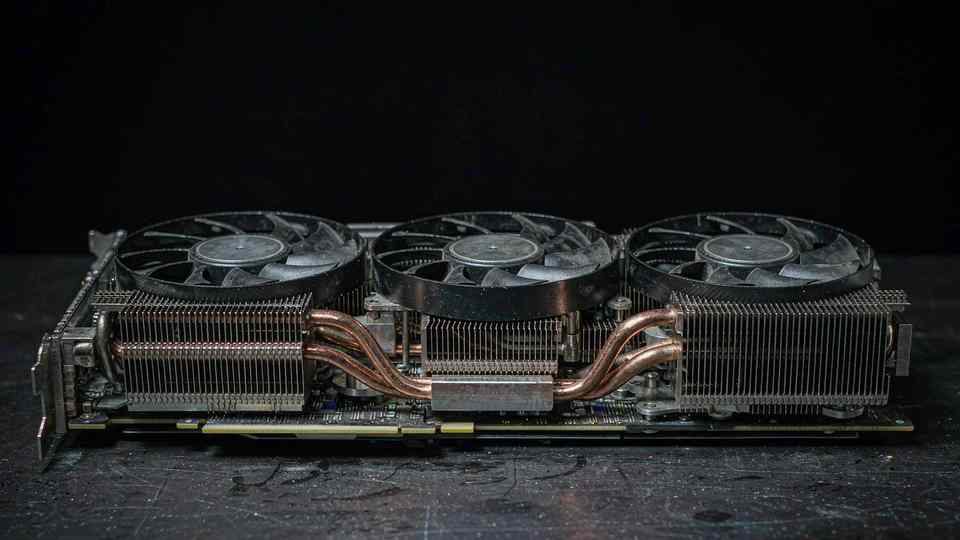
There is a number in the gpu-unlock README that made me put my coffee down: an RTX 4090 goes from 165 to 329 TFLOPS of BF16 matrix math. Not by overclocking. Not by a hacked VBIOS. By writing two values into the card's speed selectors before the NVIDIA driver loads.
The project has been climbing GitHub's monthly trend list all autumn and sits around 17,700 stars. It is a Linux kernel module, GPL-2.0, maintained by one person who signs off the README with a request that you help him buy more GPUs.
What NVIDIA actually ships
GeForce cards ship with their tensor cores capped at half rate for FP16, BF16 and TF32 math with FP32 accumulation. That is not a niche instruction set — it is what nearly all unquantised inference and virtually all fine-tuning uses. The same silicon sold as an RTX A-series or a datacenter part runs at the full rate.
This is not a secret. It is market segmentation, and the README says so in one line when a user asks why NVIDIA handicapped the card: "they want businesses to purchase the professional cards without these limitations at significantly higher prices."
The unlock is not a driver patch and not a firmware flash. It is a module that runs in the initramfs, before nvidia binds the card, writes the speed selectors (SS0 0x88888888 selects the full BF16 rate, a 4-bit SS1 0x8 enables IMLA4), and performs a function-level reset. The technique combines an existing unlock approach with careful timing. Because nothing on disk is modified, a new NVIDIA driver release does not undo it.
The gains are real but not uniform
The headline numbers are dense-matrix throughput, and they are large. An RTX 3060 goes from 27 to 51 TFLOPS. A 3090 goes from 75 to 125. A 4090 doubles at the peak rate — with the caveat, stated plainly, that the 4090 runs out of power before it runs out of tensor cores, so real workloads gain much less than the peak suggests.
Real workloads are where it gets interesting, because the spread is enormous:
- LLM prefill / prompt processing (FP16, BF16, AWQ, GPTQ): +25–55%
- Time to first token: 25–30% lower
- LoRA and full fine-tuning in BF16: +25–50%
- Image generation (SDXL, SD 1.5, DiT models in ComfyUI): +30–55%
- Video generation with BF16 compute (Wan 2.2): +15–20%
- FlashAttention and SDPA kernels: +50–60%
- llama.cpp / Ollama with quantised GGUF: 0–15%, mostly at long context
- Token-by-token decode, INT8/FP8/INT4, gaming, plain FP32 CUDA: no change at all
That last row is the one people miss. If your workload is memory-bandwidth-bound decode — which is most chat inference on a single card — you get nothing. The unlock buys matrix throughput, not bandwidth. Anyone running a 4-bit model at batch size one should close the tab.
Where it pays is prefill, fine-tuning, and diffusion. A 30–55% speedup on image generation is a meaningful change to how many iterations you can afford in an afternoon, and it costs nothing at the wall except heat.
Why "bit-identical" is the interesting claim
The README states that outputs are bit-identical before and after; only the speed changes. That single sentence separates this from overclocking in a way that matters legally and practically.
Overclocking changes results, can corrupt long training runs, and voids warranties in ways vendors can detect. Removing a rate limiter does not change the arithmetic — the same instructions execute in the same order, just more of them per cycle. If you have a reproducibility requirement, you keep it.
It also means the only real risks are thermal and electrical. The README's answer is calibrated: standard throttling and power management remain intact, so the card should downclock rather than cook. That is plausible for a desktop with airflow. It is also, obviously, not a guarantee you should bet a rented workstation on.
Installing it, and what breaks
Linux only, and the install is three steps if your distribution is Arch, Debian/Ubuntu or Fedora:
git clone https://github.com/Zagitta/gpu-unlock
cd gpu-unlock
make install
Then append gpu_unlock.targets=all to the kernel command line — or a comma-separated list of PCI addresses if you only want specific cards — and reboot. Verification is journalctl -k -b | grep gpu_unlock.
Card support is where the project is honest about its own limits. Ampere (RTX 30) is marked stable with over a hundred user reports. Ada (RTX 40) and Turing (RTX 20) are experimental. Blackwell (RTX 50) is unsupported and, per the author, unlikely to happen.
Two failure modes are worth knowing before you try. Laptops lose the unlock whenever the discrete GPU powers down, which many do when idle; turning off runtime power management helps on some models and not others. And suspend to RAM resets the selectors, though the module re-applies the unlock on resume by default, adding about a second.
Windows exists only as a third-party port the README links to with a "your mileage may vary." It also warns, in the flat tone of someone who has watched this happen, that there are crypto coins and installers floating around using the project's name, and none of them are his.
The part nobody wants to write
Half of the AI compute in the world's gaming PCs is sitting behind a firmware switch that exists to protect a price tier. That is the actual finding here, and it is bigger than one repo.
Once you know it, some other things look different. Cloud GPU pricing is set against cards that have the limiter off. A used 3090 has been quietly worth more than its sticker for two years. And the entire "you need a datacenter GPU for serious inference" argument gets a little softer when a kernel module recovers 65% of the tensor throughput on a card that costs a tenth as much.
There is a legitimate counter-argument, and I'll make it: segmentation is how NVIDIA funds the software stack that makes these cards usable in the first place. CUDA did not pay for itself. Unlocking a consumer card is not stealing, but it is also not free — the cost is carried by everyone who buys the professional part.
That is an argument about fairness, not about whether the switch exists. And arguments about fairness do not usually stop people with a spare Linux box and a fine-tuning job that needs to finish by Friday.
If you're going to try it
Do it on a machine you can afford to reinstall. Check your generation first — Ampere is where the reports are. Benchmark before and after with the workload you actually run, not with a synthetic GEMM, because the whole story here is that the gain depends entirely on whether you are bound by matrix math or by memory bandwidth.
And read the FAQ. The author answers the question "does this hurt my GPU" with a reasoned no, and the question "why did NVIDIA do this" with a one-sentence answer that is more useful than most vendor whitepapers.
Related articles
AMD Got 19 Percent for Being the Other Option
Money did not leave AI. It left the one name with a governance problem and went to the two without one.
The $99 Billion Loop Nvidia Built Around Its Own Customers
Selling shovels is a good business. Lending money to the people buying shovels is a different one.
The 74 Percent Gross Margin Has a Shelf Life
Three forces arrive in the same four quarters, and each one costs about $3 billion per point.
175,000 Signatures Will Not Put Him Back. Here Is What Would.
The longer the campaign takes to win, the weaker its case becomes. That is the trap built into it.