
Physicl Sells 10,000 Rooms. The Robots Need the Corners.
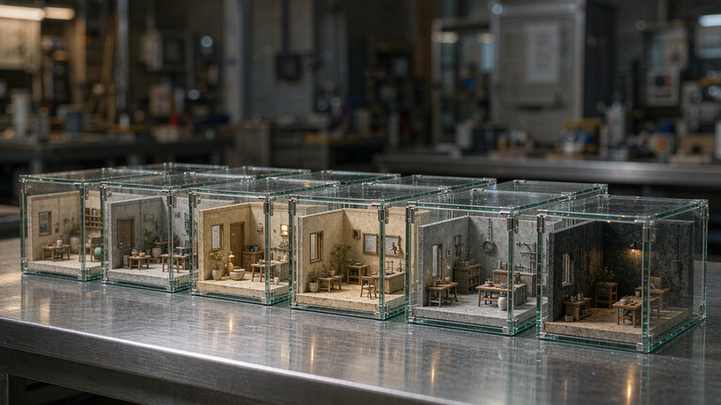
Physicl raised $10 million in seed funding on November 6, led by Inovia Capital with US Venture Partners participating. The same day it opened a beta of Studio, an application that generates 3D scenes and exports them as training data.
That sounds like a dozen other companies until you read what Studio actually ships. Ten thousand prebuilt 3D environments. A hundred thousand object assets that can be placed, swapped and rearranged. Adjustable lighting, materials and camera paths. And with every scene, the labels come along: depth maps, object segmentation, camera positions.
The labels are the product. The pictures are the packaging.
The cup on the counter
Alex de Vigan, Physicl's founder and CEO, explains the target customer with a kitchen. A home robot can recognise a cup on a clear counter. Put clutter in front of half of it, or let the sun go down so the shadows in the room change, and the same robot misses it.
That failure is the reason this company exists, and it is easy to see why nobody has fixed it. A dataset of a cup on a clean counter is cheap to collect. A dataset of the same cup behind a cereal box at 4:40pm in November, in a kitchen with a window on the west side, is expensive to stage and almost impossible to find in the wild.
Physicl's claim is that you can describe that kitchen in plain language, adjust the variables until it matches the failure you saw, and export a few thousand variations with ground truth attached. Ground truth here means something specific: the system built the scene, so it knows exactly where every surface and object sits. No human drew a mask around the cup. No labeler guessed the depth.
Hand-labelled real footage is slow, expensive, and wrong in ways that propagate. A synthetic scene is wrong in ways the system can state.
What Studio actually contains
The beta ships with 10,000 environments covering indoor and real-world settings, more than 100,000 assets, and what the company describes as billions of possible scene variations. You can start from a library environment or describe the scene your model fails in.
The workflow is unremarkable in the way that useful tools usually are. Pick or describe a scene. Adjust lighting, camera viewpoint, object placement. Export synthetic images or video for training. Repeat.
The adjustment list is where the engineering sits. Photorealism is not the hard part anymore; a diffusion model will give you a beautiful kitchen. The hard part is that the beautiful kitchen has no idea how far the counter is from the lens, and a depth-estimation model trained on it has learned nothing.
One customer number, and who produced it
Physicl's named early customer is SpAItial, a world-model company led by Matthias Niessner, a professor at the Technical University of Munich. SpAItial's models build explorable 3D spaces from 2D imagery. According to Physicl, adding its synthetic data to SpAItial's training mix more than halved the model's reconstruction error on real rooms.
Two things are worth separating in that sentence. The result was reported by the vendor. The evaluation was run by the customer, which is better than a vendor-run demo and still not an independent benchmark. One customer, one task, one metric.
Niessner's own description of the bottleneck is more useful than the number. Curation is manual, he told TechCrunch, and the cycle is long. What interests him is generating data on the fly, driven by what the training run is currently getting wrong: the model reports it needs more examples of a particular condition, and the data appears.
That is a different product from a static asset library, and it is the one Physicl says it is building toward. De Vigan describes customers feeding in trillions of images or millions of hours of LIDAR, converting them into 3D representations, and generating billions of permutations. The company also lists Meta, World Labs, Epic Games, AWS, NVIDIA and TUM among its work.
Read that list as pipeline, not as endorsement. The names establish that Physicl is selling into the right buildings.
The part the press release leaves out
Physicl has not disclosed its valuation, its pricing or its revenue. Studio is free in beta for robotics developers, universities and labs, which is the standard way to buy design partners before a price exists.
The competitive field is crowded and the boundaries are blurry. Companies collect real data, label real data, generate synthetic data, sell simulation engines, sell robot foundation models, and increasingly do three of those at once. De Vigan concedes the point directly: the space is very young and very blurry sometimes.
There is also a structural question about the business. If the value is in targeted post-training data for specific failures, then the customer's ideal outcome is to fail less, need less data, and eventually stop buying. Data infrastructure companies live with that tension. Some of them answer it by becoming tooling, which is what Physicl says it wants: the system a team keeps running as its models change, rather than a vendor shipping files.
Whether customers see it that way depends on how the export works. A team that treats Studio as a one-off purchase will run it once, take the data, and leave. A team that wires it into a training loop, where each evaluation round identifies a weakness and the next data batch targets it, has bought a subscription to a process. Physicl's pitch only works in the second case, and the product needs automation that does not exist in a beta to make the second case real.
Why this is a data problem and not a compute problem
The robotics industry has spent two years arguing about embodiment, model architecture and action representations. Physicl's pitch is blunter. Language models had the internet. Robots have nothing equivalent: no archive of grasps, navigations and recoveries across millions of real homes and warehouses.
There are three ways to close that gap, and each has a cost structure. Collect in the real world: accurate, slow, and bad at rare events, because rare events are rare. Teleoperate: high quality, and it consumes human hours in direct proportion to data volume. Simulate: cheap and scalable, but only useful if the simulated world behaves like the real one.
The sim-to-real gap is the whole bet. Physicl is arguing that the gap is narrower than people think when the assets carry correct geometry, materials and physics, and that the remaining distance can be covered by generating the specific conditions where a model breaks.
Whether that holds is not settled by a launch. More customer evaluations, across different model families and tasks, would settle it. Until then the honest summary is that a $10 million seed bought a plausible answer to a real bottleneck, plus a beta with 10,000 rooms in it.
The robots will tell us. They always do, eventually, in a kitchen at 4:40pm.
Related articles
Chinese text in video always turns to mush. Dreamina handed the typesetting to code
Dreamina launched Motion Studio on November 10. It no longer generates frames; the model writes code that lays out text, shapes and pacing. Chinese titles stop blurring, but whether the content is right is still on you.
A community spreadsheet of taps that turns off the ads inside Chinese Android builds
A no-root tool that switches off the ads Chinese phone makers ship inside the system UI. Its method is a hand-written tap script per phone model, maintained by volunteers every time a ROM moves. It works, and the maintenance is the point.
GPT Image 2.6 held the token price and raised the bill
GPT Image 2.6 kept every token rate from 2.5 and still costs more per image, because more of the work now happens in output tokens. Eleven days into the ramp, the pricing structure says more than the leaderboard does.
Someone rebuilt IDM from the outside and wrote down what they did not touch
A Rust reimplementation of Internet Download Manager claims 5x the speed and 86 languages. The more interesting document is the paragraph explaining how it was built without copying anything.