
LTX 2.5 Wants to Render Your Blocky Blender Draft Into a Finished Shot
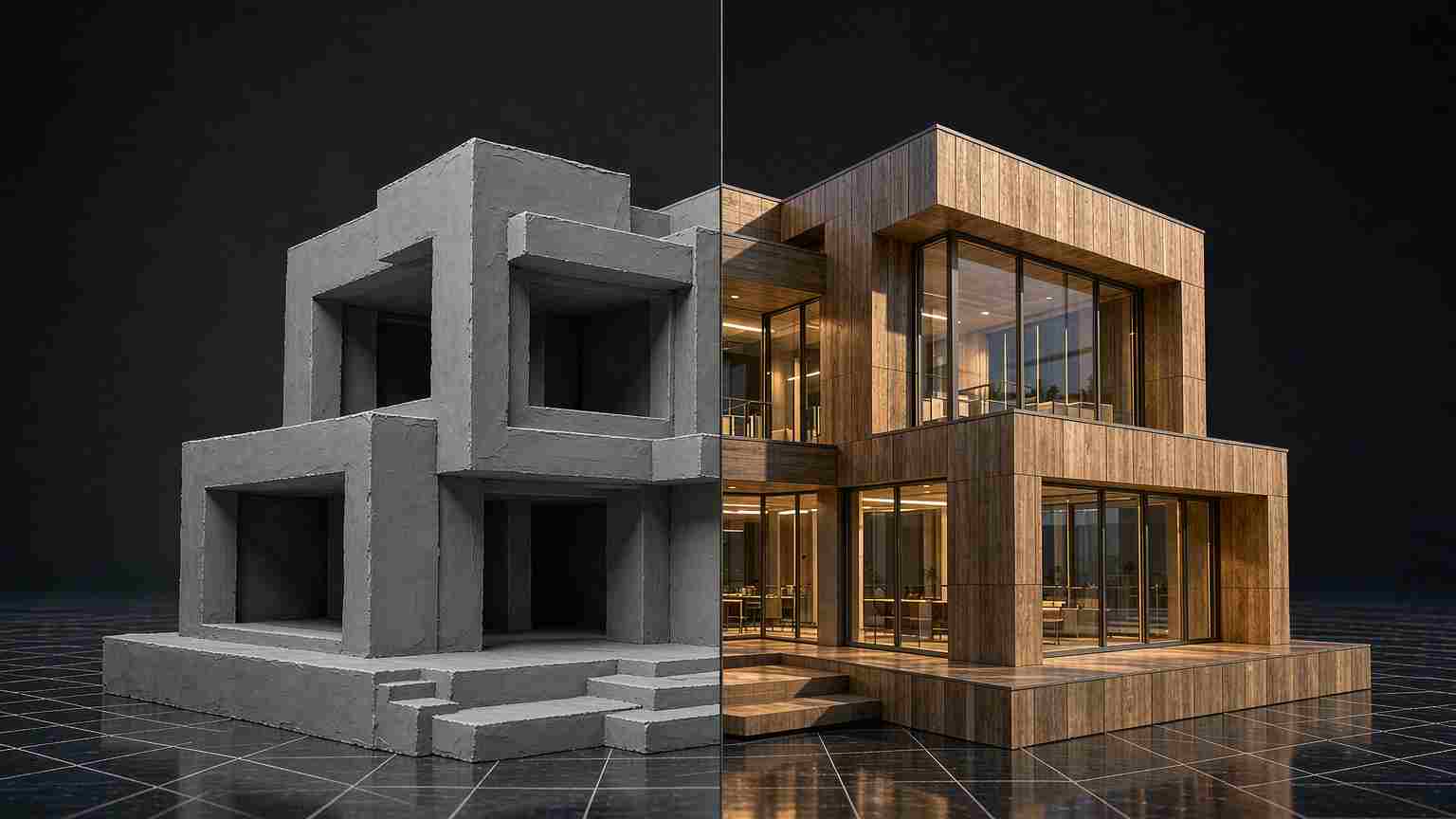
Lightricks has released a new adapter for its LTX 2.5 video model that targets a very specific and very familiar problem: the gap between a rough 3D animation and something you would actually show someone.
The tool is what it calls Layout-to-Render, delivered as an IC-LoRA that runs on the LTX 2.5 foundation model. You feed it a clay viewport animation or a low-quality playblast, the kind of blocky grey preview that comes out of Blender or Unreal, and it renders the same shot as a finished, lit, textured piece of video. It preserves the camera movement, the framing and the placement of objects, and takes its art direction from a reference image.
Why this is a different kind of tool
Almost every video generator on the market works the same way. You describe what you want, and the model decides everything: where the camera goes, what the subject does, what the scene looks like. That is fine for a one-off clip. It is a poor fit for production, where the whole point is that you decided the framing on purpose.
Layout-to-Render inverts the division of labor. The layout controls motion and composition, because you already blocked it out in 3D. The generative model handles only the look. That separation is what makes shot iteration predictable, because changing the look does not scramble the choreography, and adjusting the camera does not require re-rolling the entire clip and hoping.
For anyone who has spent an afternoon generating text-to-video clips and discarding the ones where the camera drifted a few degrees off, this addresses the real complaint. The failure mode of text-to-video is not that the images are ugly. It is that you do not control what happens. A director who wants a slow push-in does not want to re-roll until the model agrees. They want to specify the push-in and move on.
The pipeline it slots into
The adapter is designed to fit existing 3D workflows rather than replace them. It supports Blender and Unreal and similar tools, running through local ComfyUI and Python pipelines. The idea is that an animator blocks a shot the way they always have, renders a cheap preview, and then spends generative compute on the final look instead of on guessing.
That is a meaningful shift in what these models are for. The first wave of video generation competed on spectacle, on clips that looked impressive in isolation. The second wave, if this is a sign of it, competes on fit: how cleanly a model drops into a pipeline a professional already uses, and how little the professional has to change their process to get value out of it.
There is a reason this matters more than it sounds. Studios do not adopt tools that require rebuilding their process. They adopt tools that plug into the process they already have. A model that speaks the language of viewport previews and shot blocking meets animators where they are, which is a very different proposition from one that asks them to describe a scene in a paragraph.
The honest costs
Two things temper the promise. The first is hardware. The 22 billion parameter LTX 2.5 model and its required stack raise both setup cost and VRAM requirements, which puts it out of reach for casual users and pushes it toward people who already have a GPU rig for 3D work.
The second is that the output is generative, not accurate. The model does not preserve geometry at the pixel level, so artists still have to review the result for continuity, alignment and anything that drifted between frames. Source audio is not carried through, and frame counts may be trimmed to fit the pipeline's supported format. This is a finishing tool, not a replacement for the renderer, and treating it as one will lead to disappointment.
The two costs point at the same practical truth: this is software for people who already have a pipeline, and its value shows up in saved hours, not in the ability to do something impossible. If you do not already block shots in 3D, the tool has little to offer. If you do, the arithmetic changes quickly.
What it means for the open video race
LTX 2.5 itself is open-weight, and the broader story of the last few months has been open video models getting genuinely good. Tools like this adapter are how that openness turns into adoption. A strong model with no workflow around it is a demo. A strong model with a layout-to-render path, ComfyUI nodes and Blender integration is something a studio can actually use.
There is also a quieter point about where differentiation is heading. When several models can produce a beautiful five-second clip from a text prompt, the competition moves to control. Which model lets you specify exactly what you want, hold it across a sequence, and change one thing without breaking the rest. Layout-to-Render is Lightricks answering that question with a 3D-first workflow, betting that the people who care most about control are the ones who already think in shots.
What it does not replace
It is worth being clear about the boundary. Layout-to-Render does not remove the need for 3D work. Someone still has to block the shot, get the camera right and set up the scene. What it removes is the expensive final render pass, and the guesswork of trying to describe a specific shot in words. That division suits the way studios already staff projects: a small team handles layout, and the rendering budget goes toward look development rather than toward iterating on camera moves. The tool changes where the effort lands, not how much imagination the project needs.
The bigger shape of it
The trajectory here is worth naming. Video generation started as a way to make clips that did not exist. It is becoming a way to make the clips you already planned cost less to finish. Those are different products, aimed at different buyers, and they reward different kinds of quality.
The first kind rewards realism and surprise. The second rewards fidelity to a plan and predictability across many shots. LTX 2.5's adapter is clearly aimed at the second, and it is a reasonable bet that the money in professional video production sits there. A studio does not need a model that can invent a shot. It needs a model that can render the shot it already drew, over and over, without drifting.
Whether Layout-to-Render delivers that at production quality is something artists will decide by using it. But the direction is the right one for the people who pay for this software, and that alone makes it more than another clip generator with a new name.
Related articles
Agility Digit 5 Ships With a Safety Case, Not Just a Spec Sheet
A warehouse floor is not a lab. Certification is the gate, not the demo.
Frontier Agents Finished 30 Percent of a Research Workflow. That Is the Number.
Agents can run research. Inventing the procedure is still out of reach.
Figure AI Locked In $3.5 Billion of Compute Before It Has a Product to Sell
The bet is that generalisation is a compute problem. The field has not settled that.
OpenAI Finally Put Transparent Backgrounds in the Image API
A small feature that deletes a whole step from the pipeline.