
The Numbers Behind AI Image Generation: A 99 Percent Price Drop Ate Stock Photography
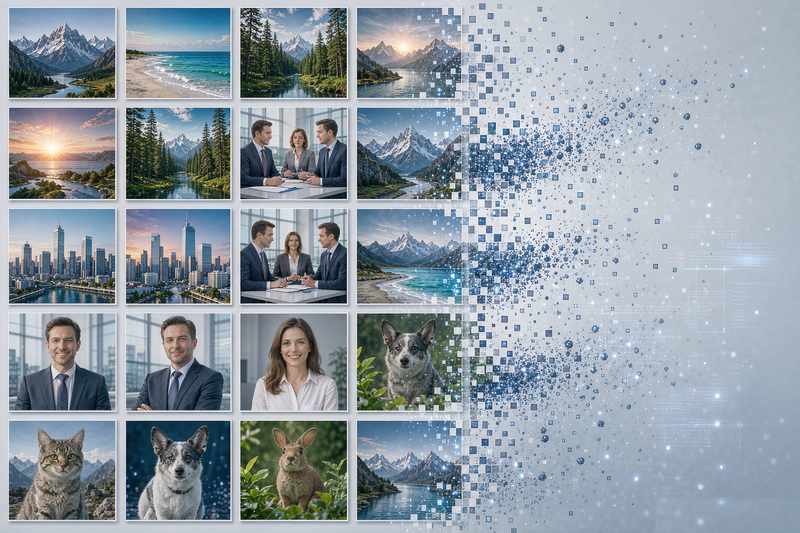
It is easy to miss how much the economics of images have shifted, because the change happened quietly and everywhere at once. The numbers tell the story better than any single product launch.
The AI image generation market is on track to hit roughly fifteen billion dollars by 2027, growing at around 60 percent a year, driven by marketing, gaming, and social media. Those are big round figures, but the sharper data point is what happened to the cost of a picture. A stock photo that used to cost fifty dollars now costs about ten cents when it is AI generated. That is a 99 percent drop, and it has consequences that are still unfolding.
The stock photography disruption
The most visible consequence is in stock photography. Around 40 percent of new stock photos are now AI generated, and the reason is not aesthetic. It is arithmetic. When the cost of producing an image falls by two orders of magnitude, the business model built on selling individual images at a premium stops making sense.
The old stock photo economy worked because a photographer had to be paid, a shoot had to be set up, and the cost had to be recovered across a limited number of licenses. An AI image has none of those costs. The marginal cost is compute, and compute is cheap and getting cheaper.
This does not mean photographers are out of a job, but it does mean the generic end of the market is gone. The stuff that used to be bread and butter, a smiling business person, a handshake, a sunset over a city, is now a commodity. What survives is the work that a model cannot fake: real people, real places, real events, and the trust that comes from knowing a photo is not fabricated.

The user base has hit scale
The adoption numbers are the part that gets quoted least and matters most.
Midjourney reports more than sixteen million users. Stable Diffusion has passed twenty million downloads. And DALL-E, before its retirement, sat inside ChatGPT with a couple hundred million users who could generate an image without ever installing anything.
That last number is the important one. The growth of AI image generation stopped being about people who wanted to use an image tool and started being about people who already had a tool open for something else. When image generation is a feature inside a chat app, an office suite, and a social platform, the addressable market stops being "creators" and becomes "everyone."
The workflow is already hybrid
The most telling statistic for how this actually plays out in practice: roughly half of graphic designers now use AI for mockup generation and ideation before finalizing in Photoshop or Illustrator.
That is the realistic shape of AI adoption, and it is less dramatic than the headlines. Designers are not being replaced. They are using AI to generate quick mockups and explore ideas, then doing the real finishing work in their normal tools. The AI does the quantity; the human does the quality.
It is the same pattern as stock photography. The commodity layer got automated. The craft layer did not. The difference is that now the commodity layer is nearly free and instant, which means more of a designer's time goes to the part that actually requires judgment.
The uncomfortable numbers
Not everything in the statistics is a success story.
Around 65 percent of artists say they worry about style mimicry, and that concern has driven the rise of "no-AI" tags and opt-out databases. The worry is legitimate. A model trained on a living artist's work can produce images in that style, and the legal and ethical boundaries are still being worked out.
On the technical side, the machines are not perfect. Even the best models still produce subtle errors, mangled hands, incorrect text, in roughly five percent of images. That number keeps shrinking, but it has not hit zero, and for work that has to be correct, that five percent is the reason a human still checks the output.
What the numbers do not tell you
Statistics compress a messy reality into a clean line, and the mess is where the interesting part lives.
The 40 percent figure for AI stock photos, for instance, hides the split inside it. AI dominates the generic, interchangeable end of the market, the smiling handshakes and the sunsets. It barely touches the top end, where buyers pay for real editorial photos, real people, and the verification that comes with them. The number is large because the bottom of the market is large, not because AI replaced the whole thing.
The adoption stat about designers has the same shape. Half of designers using AI for ideation does not mean half of design work is automated. It means the cheap exploratory part is automated, and the expensive finishing part still happens by hand. The AI produces more options, and the human chooses between them. That is augmentation, not replacement, and the distinction matters for anyone trying to guess where their own job lands.
Even the 99 percent cost drop is less clean than it sounds. The marginal cost of generating one image is near zero, but the cost of getting one good, on-brand, legally clean image is not. Retries, approvals, edits, and the risk of using something you cannot license all add back up. The price of a pixel fell off a cliff. The price of a usable asset fell far less.
What the numbers point toward
Read together, the statistics describe a market that has finished its novelty phase and entered its consolidation phase.
The cost curve has collapsed, which kills the old stock photo model and opens up volume applications that were never economical before. The user base has reached mainstream scale, which shifts the competitive battleground from "who makes the best image" to "who is already in the app you use." And the workflow is settling into a hybrid, with AI handling iteration and humans handling judgment.
The next frontier is already visible in the same data: 3D generation and video animation from single images. The image models got good, then they got cheap, then they got everywhere. The same arc is now starting over for video. The only thing that is certain is that the next 99 percent price drop will be even less visible, because nobody will stop to notice that a thing they use every day got cheaper again.
Related articles
The Open-Source AI Image Stack Is Being Rebuilt, One Workflow at a Time
Workflow1111 recreates AUTOMATIC1111 with 73 nodes and 11 pipelines. What the community rebuild means for local image generation.
The Next AI Frontier Is Turning a Single Still Image Into a Moving Scene
How the physics problem got solved, the open-source arrivals, and which image-to-video tools are actually usable today.
Flux 2 vs Stable Diffusion 3.5: The Open-Source Image Race Has a Clear Leader
Flux 2 leads on quality, Stable Diffusion 3.5 keeps the deepest ecosystem. How to choose between them in 2026.
Who Owns an AI-Generated Image? Copyright, and the Firefly Loophole
Licensing, indemnification, and Adobe Firefly's legal cover: what you can safely publish in 2026.