
The Open-Source AI Image Stack Is Being Rebuilt, One Workflow at a Time

There is a quieter story running underneath the model launches this month, and it is happening on Hugging Face. The open-source tooling that powers local AI image generation is being rebuilt, and the people doing it are not the big labs. They are the community, working in public.
The clearest example landed on September 11, 2026, when Hugging Face released Workflow1111, a project that recreates most of AUTOMATIC1111's functionality using gr.Workflow. If that sentence means nothing to you, the short version is this: the most popular local interface for Stable Diffusion, the tool that got a generation of people running image models on their own GPUs, is being reimplemented in a modern, more maintainable form.
What AUTOMATIC1111 was, and why it matters
To understand why the rebuild is news, you need a little history.
For years, if you wanted to run Stable Diffusion locally, you used AUTOMATIC1111's web UI, known to everyone as A1111. It was the default. It handled text-to-image, image-to-image, inpainting, upscaling, and a sprawling ecosystem of extensions. Most of the tutorials, most of the LoRA training scripts, and most of the community's muscle memory ran through it.
The problem is that A1111 got old. The codebase accumulated years of patches, the extension system became fragile, and the underlying Gradio version it was built on aged out. Meanwhile ComfyUI, the node-based alternative, took over the power-user end of the market with a cleaner, more composable design. A1111 did not disappear, but its momentum stalled.
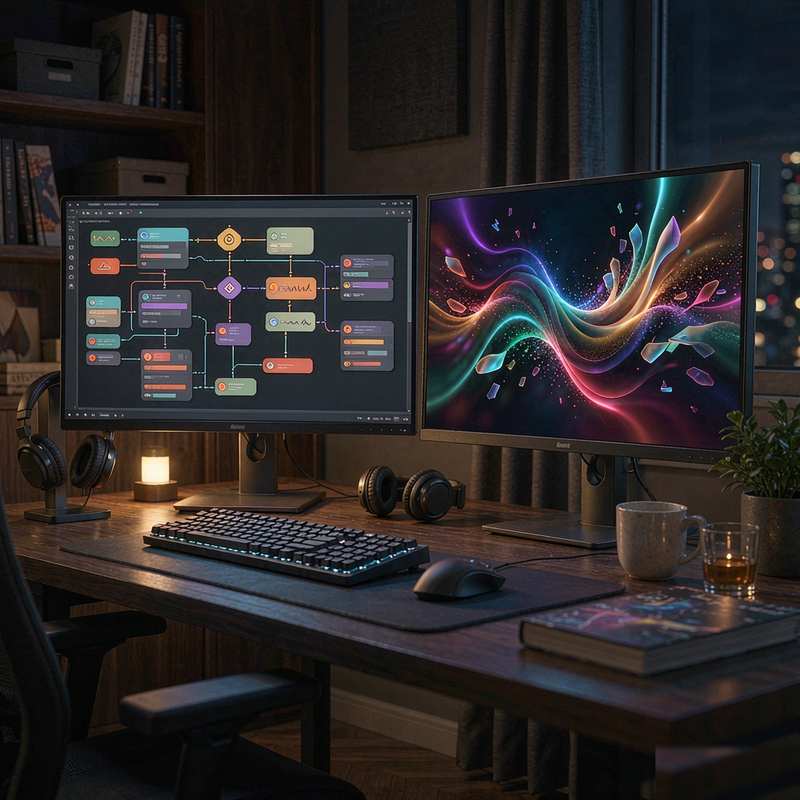
Workflow1111 is an attempt to rebuild the A1111 experience on top of gr.Workflow, the newer, more structured way of building Gradio apps. It is not a fork. It is a reimplementation, done in the open.
What the rebuild covers
The scope is impressive for a community project. Workflow1111 rebuilds 73 nodes across 11 media pipelines, covering most of what made A1111 the default.
The list includes text-to-image, image-to-image, and high-resolution fix, the three core jobs. It also includes a prompt matrix, which lets you test combinations of prompts and parameters in a grid, and a VLM reverse-prompt feature that reads an image and suggests a prompt from it. There is inpaint mask generation, ControlNet-style preprocessors for guiding the model with edge and pose information, background removal, PNG metadata handling, and even image-to-video.
That last one is the tell. The original A1111 was a still-image tool. The rebuilt version includes video, which shows the project is not just recreating the past. It is rebuilding the stack for where the field is going, not where it was.
Why the community is doing this itself
There is a pattern worth noticing. The closed labs ship models. The open-source community ships the plumbing around them.
The models get the headlines, but the plumbing is what determines whether a model is actually usable. A great model with no decent interface is a research artifact. A good model with a great interface becomes something a hobbyist can run on a laptop.
The community rebuilds this plumbing because the closed companies are not interested in it. A company like OpenAI has no incentive to maintain a local Stable Diffusion UI. The incentive to keep local tooling alive comes from the people who use it, and they do the work for the same reason any open-source maintainer does: they need the tool, so they build it.
ComfyUI and the two-track ecosystem
The local ecosystem now runs on two tracks.
ComfyUI is the power tool. It is node-based, which means you wire up your own pipeline from individual operations. It is harder to learn but far more flexible, and it has become the standard for people who want precise control. It updates constantly, and the latest releases have pushed further into the same territory, with new versions landing as recently as mid-September.
Workflow1111 and its ilk are the accessibility track. They reproduce the familiar, linear A1111 experience for people who do not want to learn a node graph. The two tracks serve different people, and they coexist because the use cases are different.
The significance of the Workflow1111 rebuild is that the accessibility track is no longer being left to rot. For a long time it looked like the choice was between an aging A1111 and a ComfyUI that demanded real technical skill. The rebuild gives people a maintained, modern option in the middle.
Should you bother with local tooling at all
For most people, the honest answer is no, not at first.
The cloud tools are better for most jobs. They are faster to start, they do not require a good GPU, and they do not ask you to maintain anything. If you just want to make an image, open a web app and make it.
Local tooling earns its place for three specific reasons. The first is cost at scale. If you are generating thousands of images, the per-image cost of your own hardware beats any API. The second is control. Local tools let you touch every parameter, swap in custom models and LoRAs, and build pipelines the cloud tools will never expose. The third is privacy. If your images or your prompts are sensitive, running locally means they never leave your machine.
The catch is the learning curve. Local tooling expects you to understand a little about models, a little about hardware, and a little about the tooling itself. That is a real barrier, and it is exactly the barrier that projects like Workflow1111 are trying to lower by bringing back a familiar, linear interface.
The practical path is to start in the cloud, and only move to local when you hit a wall. When you do hit it, the fact that the open-source stack is being actively rebuilt means the wall is lower than it used to be, and getting lower.
What it means if you do not run models locally
Most people reading this will never run a model locally, and that is fine. The cloud tools are better for most jobs, and they are getting cheaper.
But the health of the open-source stack still matters to everyone, for two reasons. First, it is where the cheap and free options come from. The open models and the tooling around them are what keep the floor of the market from rising. Second, it is where the next generation of ideas tends to appear first. Local tooling is where people experiment with the weird workflows that eventually get productized by the big companies.
Workflow1111 is a small project in the grand scheme, a reimplementation of an interface most people will never use. But it is a signal that the open-source AI image ecosystem is not just surviving the flood of closed models. It is being actively rebuilt, by people who care, for a field that is still changing faster than anyone can keep up with.
Related articles
The Numbers Behind AI Image Generation: A 99 Percent Price Drop Ate Stock Photography
Market size, stock photo disruption, adoption numbers and the hybrid workflow, explained through the statistics.
The Next AI Frontier Is Turning a Single Still Image Into a Moving Scene
How the physics problem got solved, the open-source arrivals, and which image-to-video tools are actually usable today.
Flux 2 vs Stable Diffusion 3.5: The Open-Source Image Race Has a Clear Leader
Flux 2 leads on quality, Stable Diffusion 3.5 keeps the deepest ecosystem. How to choose between them in 2026.
Who Owns an AI-Generated Image? Copyright, and the Firefly Loophole
Licensing, indemnification, and Adobe Firefly's legal cover: what you can safely publish in 2026.