
2.8 Trillion Parameters on a 4GB GPU: How AirLLM Broke the VRAM Wall

The wall everyone hits
There is a specific moment every developer who wants to run a large model locally runs into. It is not a skills problem or a cost problem. It is a number in a specification sheet: video memory. A serious open model does not fit on the graphics card most people own, and the usual fix, buying a bigger card, has a price that climbed to absurd levels.
So the field filled up with workarounds. Quantize the weights down to four bits. Offload part of the model to system RAM. Rent someone else's hardware. Each works, each costs something, and each changes the model in a way you have to live with. Then there is AirLLM, a repository sitting near the top of GitHub's trending list this month, whose README makes a claim that sounds like a typo: 2.8 trillion parameters, single 4GB GPU.
What the trick actually is
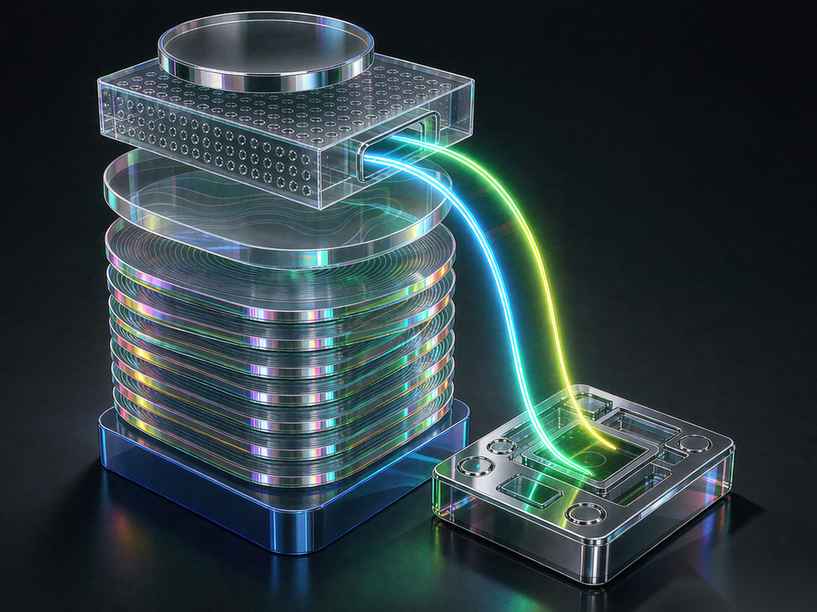
The idea behind AirLLM is not to make the model smaller. It is to stop trying to hold the whole thing in memory at once. Instead of loading every layer of the network into the graphics card before generating a token, the approach streams through the model one layer at a time, pulling each block from disk just before it is needed, using it, and letting it go.
At any instant, only a thin slice of the model needs to live in fast memory. The rest can sit on a drive. The graphics card becomes a workspace rather than a warehouse, and the size of the model stops setting a hard ceiling on the machine that can run it.
This is the same reason a person can read a thousand-page book with a very small desk. You do not need the whole book in front of you. You need the page you are on, plus a way to fetch the next one.
The honest tradeoff
If streaming layers through a small GPU were free, everyone would already be doing it, so it is worth being clear about what it costs. Reading weights from disk for every token is slow in a way that is easy to underestimate. The graphics card sits idle while it waits for data it could have used immediately if it had been resident.
The practical consequence is that these setups are good for a different set of tasks than a model loaded fully into memory. If you need a steady stream of fast responses for a chat product, streaming is the wrong tool. If you want to run a very large model occasionally, on hardware you already own, on a job where throughput matters less than simply being able to do it at all, the tradeoff flips in your favor.
It helps to place this next to the more familiar workaround. Quantization shrinks the model itself, trading a little accuracy for a smaller footprint, and it changes what the model is. Streaming leaves the model's numbers alone and moves where they live. The two are not rivals; they stack. A quantized model that is also streamed layer by layer is smaller and lighter than either technique alone, which is why the two approaches tend to show up together in practice.
There is a third, less advertised cost: the drive. Streaming weights means reading them from storage on every pass, so a slow disk becomes the new bottleneck the moment the model stops fitting in memory. People who go down this road quickly learn that the hardware that matters is not only the GPU. A fast solid-state drive can do more for throughput here than another few gigabytes of video memory.
That distinction, between interactivity and feasibility, is the one most comparisons miss. A model that runs at a crawl on your desk is still a model you can run on your desk. For a researcher without a cluster, or a developer who wants to test one specific prompt against one specific huge model, that can be enough.
Why this keeps trending
AirLLM is not new. It has been around long enough to be familiar to people who follow local inference closely. It keeps resurfacing in trending lists for a reason that has less to do with the specific implementation than with the pressure behind it.
Open-weight models keep getting larger. The best open image, video, and language models are now firmly in the range that no consumer graphics card can hold comfortably. At the same time, the price of the large-memory cards that can hold them has gone up, not down, driven by the same demand that is reshaping the rest of the hardware market. The gap between what is available to run and what is possible to run on affordable hardware keeps widening.
Any project that pushes back on that gap, even imperfectly, will keep finding an audience. The alternative is a world where the frontier of open models is theoretically available to everyone and practically available only to those with a data center. The workarounds are how the "open" in open weights stays honest.
What it does not solve
Two different things get blurred together here. Running a large model on a small GPU is a memory problem. Getting useful output from a large model is a capability question, and the two are not the same. A 2.8 trillion parameter model streamed through a 4GB card still generates text at a pace set by its disk and its bandwidth, and the quality of that text is whatever the model is, not what the workaround made possible.
There is also a licensing dimension that the technical achievement does not touch. The ability to run a model locally says nothing about whether you are permitted to use its weights for your purpose. The most impressive local-inference setup in the world is still bound by the terms attached to the model it is running.
The bigger point
The frontier of local AI is not a single breakthrough. It is a long series of unglamorous engineering decisions about where data lives, when it moves, and what you are willing to wait for. AirLLM is a good example because it is so blunt about the trade: you give up speed, and in return you get to run something that was not supposed to fit.
For the growing number of people who care more about what a model can do than how fast it does it, that is a reasonable deal. And for everyone else, it is a reminder that "this model needs X gigabytes" is a design decision as much as a hardware limit. Somebody, somewhere, is always looking for the desk that is smaller than the book.
Related articles
Two Thousand Agents Rewrote Themselves in Two Weeks: How Prime Agent Moved TypeScript into Rust
Prime Agent was rewritten by its own swarm: more than 2,000 agents moved it from TypeScript to Rust in two weeks. Here is how the orchestration and guardrails worked.
The Harness-Independent Agent: Running Any Frontier Model on Your Own Machine
A wave of open-source projects is pulling apart the old bundle of model, harness, and hosting. The pitch is simple and durable: the intelligence you rent and the machine you run it on should be separate decisions.
One Bit Is Enough: Why Microsoft's BitNet Keeps Winning Hearts
A language model made of three-valued weights sounds like a gimmick until it runs on a CPU. BitNet keeps returning to GitHub's trending charts because it questions an assumption the whole field runs on.
AI Video's New Rulebook: Machine-Readable Labels Under the EU AI Act
Article 50 transparency rules have applied since August 2026, with a machine-readable deadline and fines to match. The catch: the label is often baked in at generation time, and it is easy to strip later.