
No Rigging Required: Viggle's JST-2 Generates a 3D Scene in About a Second

Viggle published a model on October 19 that generates a 3D scene in about one second, at an inference cost below one cent. Those two numbers come from the company's own launch page, measured on an NVIDIA B200 with network latency excluded, so treat them the way you'd treat any vendor benchmark. But the architecture behind them is worth more attention than the numbers.
The model is called JST-2. JST stands for Joint Space-and-Time. Viggle describes it as a physics-native world foundation model, and the phrase is doing real work rather than decorating a press release.
What "physics-native" actually changes
Most video models learn the world through pixels. They watch enough frames and get very good at predicting what the next frame looks like, which is why they can produce a gorgeous shot of a chair and then lose the chair entirely when the camera turns around.
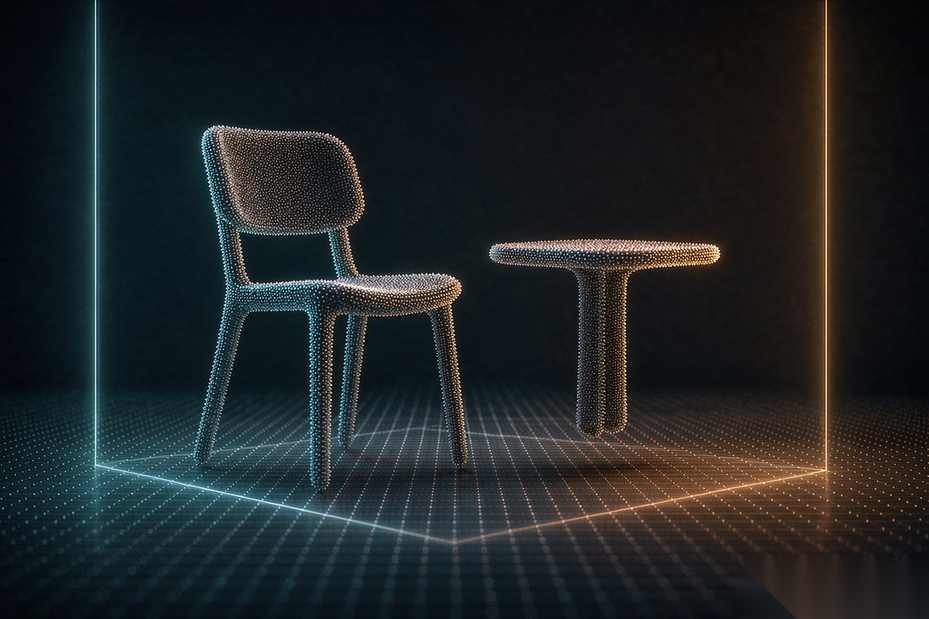
JST-2 doesn't build frames. Its basic unit is closer to an atom: a small piece of matter with a real 3D position, a material, a color, a mass, and a record of how it moves and deforms under force. Those units get tokenized into what Viggle calls Physics-Native Tokens, then decoded into 3D Gaussian splats that render in a browser.
The practical consequence is persistence. A chair stays part of the room when you look away, because it isn't a prediction, it's an object. You can orbit the result, walk to a corner the model never rendered, and the scene holds up. The model only needs to run again when you add new content.
Viggle's comparison target is World Labs' Marble, which the launch page clocks at roughly six minutes per scene against JST-2's one second. That gap isn't a tuning difference; it's feed-forward generation versus per-scene optimization. Viggle's model produces the 3D representation directly in one pass instead of fitting a scene after the fact.
The context window is a place, not a document
JST-2 accepts up to 64 input views as its spatial context window. That's an odd phrase for a 3D model, but it describes the interaction well: you expand a world one view at a time, and each new view becomes part of the context for whatever comes next.
This is how the demo works. In Viggle's launch film, a robot picks up a box in a living room. Typed instructions add a woman, then a father and a child, then send the robot across the room to hand the box to the child. The camera cuts between the room and the robot's own view. Nothing in that sequence required rerunning the scene from scratch.
Sixty-four views is a modest budget for a large environment, and it's the number to watch. Spatial context windows behave like text context windows did: the first version is impressive, the second one changes what people build.
Rigging is where this gets commercially interesting
The character feature is the part with the shortest path to money. JST-2 turns a single image, or a text description, into a 3D character that is ready to animate. No separate rigging step. No skinning pass where an artist places a digital skeleton and paints weights.
The mechanism is in the token representation. Viggle says the dynamics vectors inside its Physics-Native Tokens encode how each part of a character deforms under different motions. Those dynamics are learned from data, so the model isn't shipping a character mesh and hoping you rig it later, it's shipping a mesh plus a deformation model.
Viggle ran blind human evaluations against Meshy 7.1 and Tripo H3.1. JST-2 led both on character generation, with its strongest margin on facial detail, which is also the thing that most often gets lost between a 2D reference and a 3D result. It also led on animation readiness, particularly hand articulation and how body and clothing deform during motion.
Viggle is upfront about the weak spots: complex clothing deformation and hair movement are listed as work for upcoming releases. Anyone who has watched a generated cape clip through a generated leg will recognize both as the honest answer rather than a marketing omission.
Motion capture without the suit
JST-2 also does full-body motion from text or from a video of a real performance, which is markerless motion capture by another name. The examples on the launch page are ordinary actions: dodge and duck, forward roll, front kick, hip-hop groove, pirouette, robot dance, boxing, a scanning walk, walking through a door, brushing teeth, fast typing, pointing ahead.
None of those are hard for a human. All of them are hard for a rig, because they involve weight transfer, contact, and recovery. Getting them from a phone video into a retargetable skeleton is the step where most small studios currently pay an animator.
Where the physics is still faked
Here's the line worth holding onto. Viggle's own materials say JST-2 still uses programmed physics rules for collisions and object interactions. The next model, JST-3, is being developed to learn those interactions from data instead of having a person write the rules.
So "physics-native" describes the representation, not a solved simulation. The model knows where things are and how they move; it doesn't yet know what happens when two of them disagree about the same space. That's the difference between a world you can explore and a world you can test a robot in, and Viggle is explicit that the robot-training use case is where it's heading rather than where it is.
Viggle has said the goal for JST-3 is a complete world simulator that could sit underneath a game engine, or serve as a training ground for physical intelligence. That's a large claim with no delivery date. What exists today is a fast scene generator with unusually good character output.
What you can actually do with it this week
JST-2 is free to try inside PINOC, Viggle's browser app for 3D characters and motion. The Free plan includes 60 credits, once, which the company says covers roughly a minute of motion or up to twelve image-to-3D characters, plus one motion export and one character export. Credits don't refill on the free tier and top-ups aren't available there.
Paid tiers start around $10.39 a month billed yearly for 300 credits, and the licensing matters: free-tier output is restricted to personal projects, evaluation, and prototyping. Client work or anything monetized needs Starter or Pro. Exports come out as FBX or GLB, which means Blender, Unity, or Unreal can open them.
If you want to test the claim cheaply, the sequence that costs least is: one image, one short motion, one export. Motion runs a credit per second, so a five-second clip is five credits. Twelve ideas fit inside a free minute if you keep them short, and short is also where you'll see the hand articulation claim either hold or fall apart.
The real shift
What actually changes here isn't speed. It's that the asset and the animation now arrive together. For twenty years the pipeline has been model, then rig, then animate, and each arrow was a different person with a different file format.
Collapsing the first two arrows doesn't remove the animator. It removes the part of the job that was mostly bookkeeping, and it makes the cost of a bad idea close to zero. That's usually the point where a format changes, not when the output gets prettier.
Related articles
The Video Leaderboard's Number One Is a Talking Head
HeyGen Video leads at 64,000 weekly requests, ahead of Veo and Wan. Chinese labs hold about 54.8% of routed video traffic while Runway sits at 0.3%. What request volume measures.
VideoGen Promises Ten-Minute Videos From One Prompt. Nobody Benchmarked It.
Ten minutes is assembled from many shots, not rendered in one pass. The product is the planning harness, and the cost and quality claims are still waiting on third-party validation.
NVIDIA's OpenShell Enforces Agent Policy in the Kernel
Kernel level checks on every file, syscall and connection, plus formal verification of policy changes before they apply. The install is one line. The operational bill is the rest of the page.
FLUX 3 Max Renders 10 Seconds of Video in 11. The Benchmark Has an Asterisk.
Fal post-trained FLUX 3 for speed and got a 1139 Elo claim out of it. The vote count is preliminary, the confidence interval overlaps the leader, and the 75% discount runs three weeks.