
An Anime Model Learned to Read Stick Figures. The Gap From 0.37 to 0.83 Is the Interesting Number.
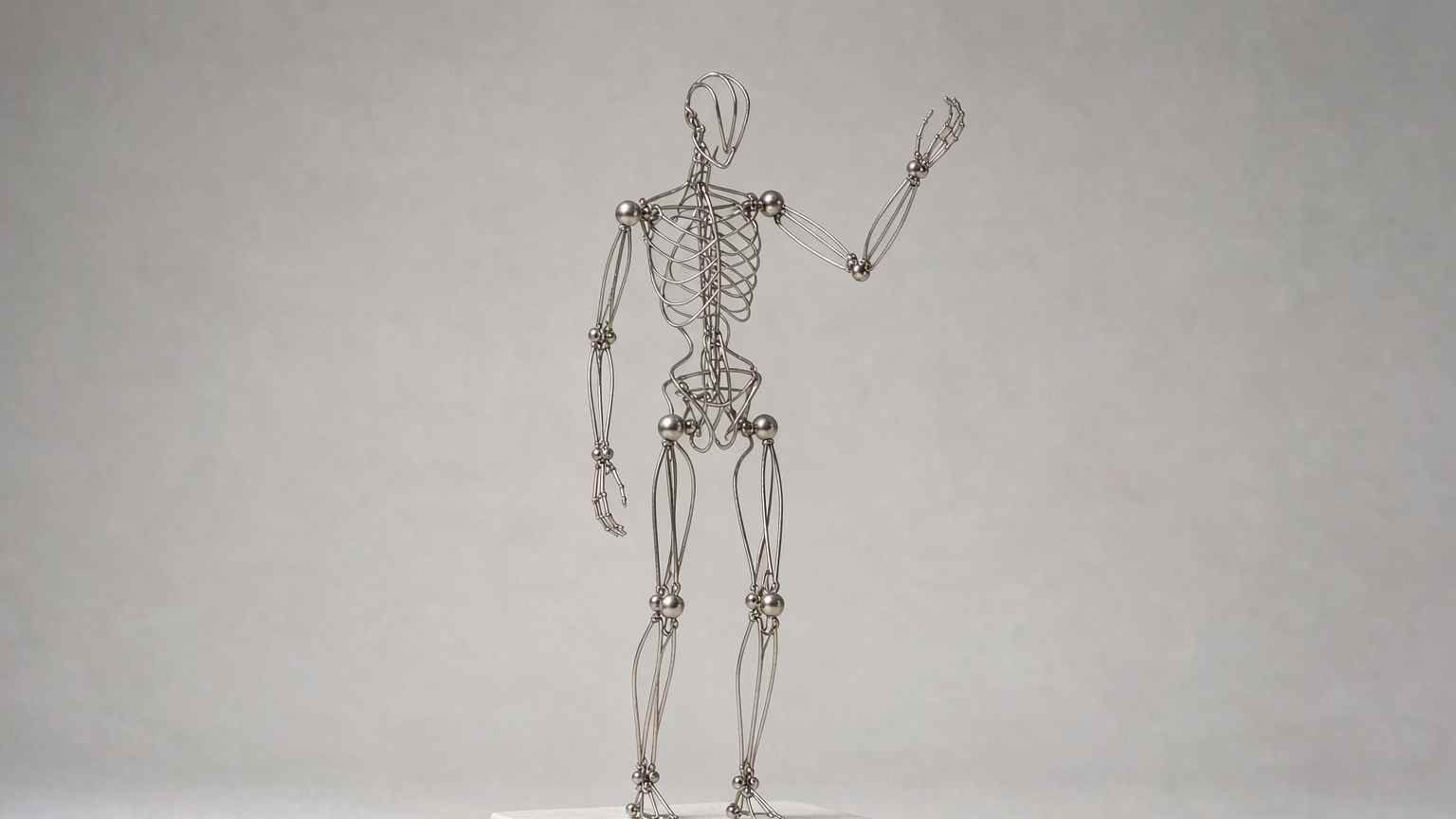
On November 2, a repository called Anima-Control-Pose appeared with a preview build of a pose guide for an anime image model. You feed it a reference photograph, its bundled detector draws a skeleton over the person, and the character follows that skeleton.
The release notes are short and unusually specific about what does not work. Running, jumping and sitting poses are the least reliable. Hands still fuse. The detector was built for photographs, so it reads anime art poorly.
That last line is the one that tells you the author has actually used the tool.
What pose control is for, and why anime needs its own
Pose conditioning is a solved problem in general image generation. Skeleton overlays, depth maps and edge maps have been standard control inputs for a couple of years, and the general-purpose models handle a photograph of a person with reasonable fidelity.
Anime is a different problem. Proportions are stylised. Heads are large, limbs are thin, hands are drawn as five clean lines rather than photographed geometry. A detector trained on photographs looks at a manga panel and produces a skeleton that is roughly right in the torso and wrong everywhere else, because the cues it relies on, joint bulges and skin shading, are not present.
So an anime pipeline needs two things at once: a control signal the model can follow, and a way to derive that signal from whatever the artist actually has, which is usually a sketch, a photo reference, or a rough figure.
Anima-Control-Pose takes the second-hand route: photograph in, skeleton out, character follows. That is the workflow an illustrator with a reference photo of a pose actually wants, and it is why the tool exists.
The number and what it measures
The author reports pose accuracy going from about 0.37 without the add-on to about 0.83 with it at 1024 pixels. At 512 and 768 the gains are smaller.
Three things about that number are worth separating.
It is the author's own measure, on the author's own evaluation set. There is no third-party check, no standard benchmark, and no stated protocol for what counts as an accurate pose. The figure is useful as a direction and as evidence that the add-on does something substantial. It is not comparable to a published benchmark number.
The resolution dependence makes sense mechanically. Skeleton extraction and pose adherence both degrade when the character occupies fewer pixels, and 512-pixel anime generations have always been the hard case for control layers. That the gain shrinks there is a limitation, not a footnote.
The gap between 0.37 and 0.83 is the more interesting half. A model that scores 0.37 on pose adherence is not unusable; it is a model that produces a character in roughly the right attitude with the limbs doing something adjacent. Artists work with that by rerolling. Going to 0.83 turns rerolling into directing, which changes how many generations a shot costs.
Three things it still cannot do
The card lists them and they are worth taking at face value.
Running, jumping and sitting are the least reliable. Look at why. Those poses involve self-occlusion, foreshortening and contact with an unseen surface. A skeleton encodes joint positions, and joint positions are least informative exactly when the body folds into itself. A seated character's hip angle is invisible in a stick figure.
Hands fuse. Hands are the oldest failure in generative images and the fix has never been pose conditioning. A detector produces wrist and finger keypoints at low confidence, the model paints a suggestion of a hand, and the artist redraws it. Every anime pipeline in production has a hand fix step. This one does not remove it.
The detector misreads anime art. This is the structural one. The tool sees photographs well because it was trained on photographs. If your reference is a manga panel, a sketch, or another AI generation, the skeleton it draws may be plausible and wrong, and a wrong skeleton produces a confidently wrong character.
That third limitation defines the tool's scope. It sits at the front of the pipeline, converting real-world reference into a control signal, and it is not a bridge between two anime images.
The 0.37 baseline is also a statement about the base model, and it is worth reading as one. Without the add-on, an anime model asked to follow a skeleton gets roughly a third of the pose right. Everything an illustrator has been doing to work around that, from img2img passes to inpainting limbs one at a time, comes from that number. Improving it to 0.83 reduces labour; it does not remove the step of checking the result.
What ships, and what it costs to use
The package is modest: two ComfyUI node folders, four example workflows with `pose_control_demo.json` as the entry point, and a detector of roughly 316 megabytes.
ComfyUI as the distribution channel is the norm now, and it has a side effect worth noticing. A workflow JSON is simultaneously documentation, tutorial and reproducibility artifact. If you can load the file, you can see every parameter the author used, which is a form of disclosure that most model releases never provide. It also means the tool's behaviour is reproducible on your machine and your seed, which is the only way the 0.83 claim becomes checkable by anyone other than the person who wrote it.
The weights are non-commercial. For an anime model with a large hobbyist community, that is a familiar arrangement: free for the people who make fan art, licensed separately for the people who sell it. It also means a studio cannot adopt this without a conversation, which will be the deciding factor for most professional users regardless of the accuracy number.
The pattern this release represents
Anime generation has spent two years converging on a stack: a base model, a set of character LoRAs, and control layers for pose, line art and composition. Each layer is a separate small release by a separate author, often with a workflow file and a card that lists failures.
That structure has costs. Compatibility between layers is nobody's job, and a base model update can break four add-ons at once. It also has an advantage that the polished end of the market keeps trying to buy: the failure lists are public, because the authors are users.
Anima-Control-Pose is a small release with an honest card. The interesting question is not whether 0.83 is good. It is whether the ecosystem keeps publishing the number at all, or whether the next version ships with a demo reel and no denominator.
Keep the denominator. It is the only part that lets you decide.
Related articles
The Jensen Discount: What Nvidia Loses When Its Founder Walks Out
Nvidia lost roughly $600 billion in market value when its founder stepped down. The earnings did not change. The multiple did, and that says where the value really lived.
Chinese text in video always turns to mush. Dreamina handed the typesetting to code
Dreamina launched Motion Studio on November 10. It no longer generates frames; the model writes code that lays out text, shapes and pacing. Chinese titles stop blurring, but whether the content is right is still on you.
A community spreadsheet of taps that turns off the ads inside Chinese Android builds
A no-root tool that switches off the ads Chinese phone makers ship inside the system UI. Its method is a hand-written tap script per phone model, maintained by volunteers every time a ROM moves. It works, and the maintenance is the point.
GPT Image 2.6 held the token price and raised the bill
GPT Image 2.6 kept every token rate from 2.5 and still costs more per image, because more of the work now happens in output tokens. Eleven days into the ramp, the pricing structure says more than the leaderboard does.