
Why Every AI Face Looks the Same, and Why Viewers Are Starting to Hate It
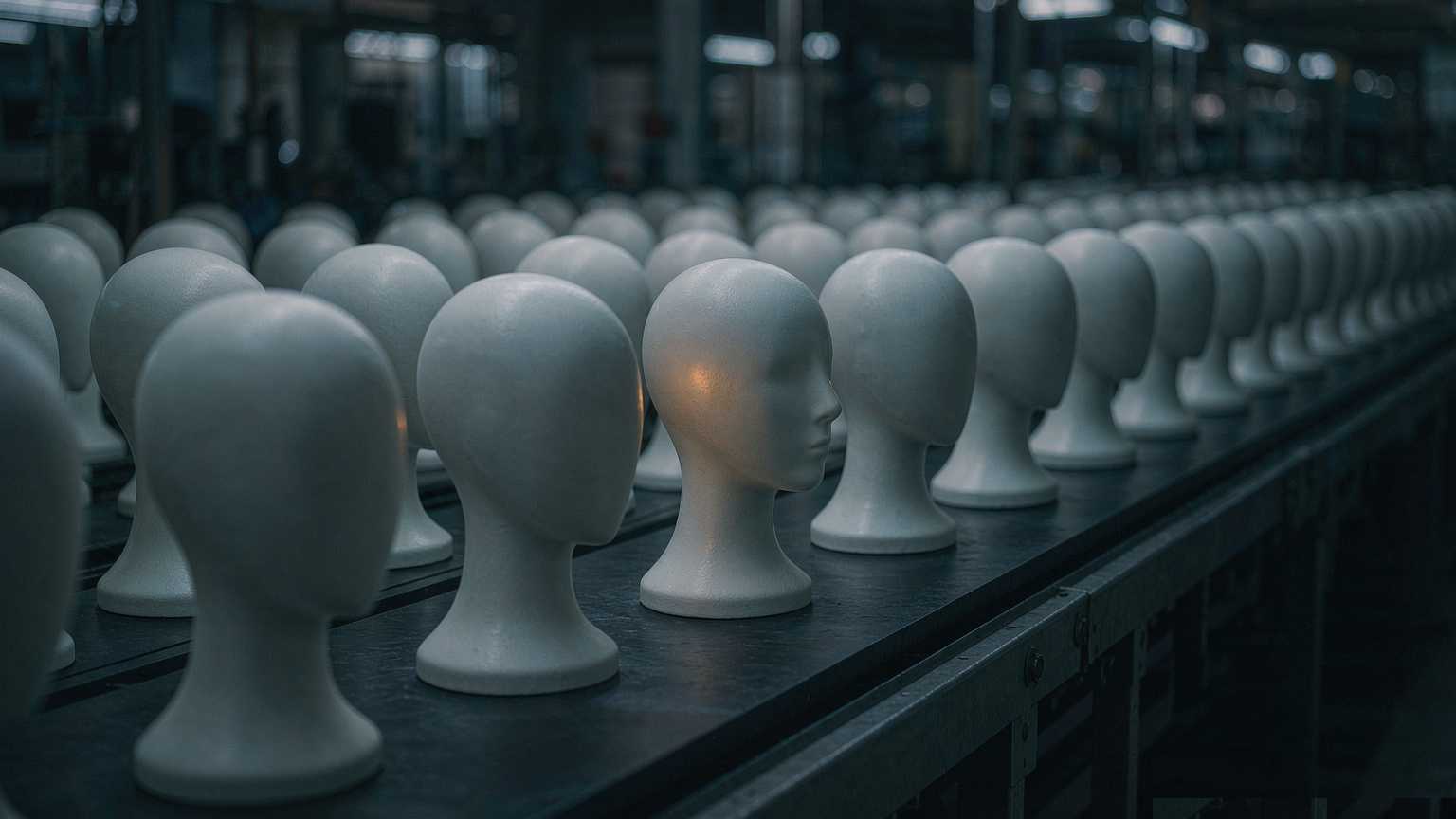
There is a moment that keeps happening in the AI drama boom. A viewer is scrolling, watches a clip, likes it, and then notices the male lead in this show has the same face as the male lead in the last show, and the one before that. Same face shape, same hair, the same center-parted fringe. The comparison screenshots have gone viral, and the reaction has a name in Chinese internet slang: physiological disgust.
The reason every AI face converges on the same face is not a mystery. It is statistics. A video model has to keep a face consistent from frame to frame, and a symmetrical, flawless, featureless face has the highest tolerance for the tiny errors that cause cross-frame flicker. Individual features, a crooked nose, a mole, asymmetric eyes, are precisely the things that break when the model re-renders the same face thirty times a second. So the model reaches for the "safe" face, the one that is the average of all the faces it trained on. What comes out is what one researcher called a statistical "average-optimal solution."
The economics push the same direction. Generative video is billed per second, and customizing an individual face means iterating on prompts, locking features, and calibrating micro-expressions frame by frame, which doubles the time. Most teams chasing a daily upload schedule skip all of that and reuse a hit template with a public face library. There is even a gray market for it: a pack of twenty thousand allegedly infringing drama clips for training sells for less than a dollar. When the training data itself is pulled from the same handful of sources, the faces it produces cannot help but look alike.
The result is a content category where the faces are perfect and interchangeable. A Tsinghua journalism professor put the problem in terms that have stuck: the algorithm can compute a beauty score, but it cannot compute the thickness of a human personality. The imperfection is the point. Freckles, a slight asymmetry, the way an eye crinkles when someone actually smiles, the way a brow relaxes when they are tired. Those are the things that let you tell one person from another, and they are exactly what a model optimized for smoothness files off.
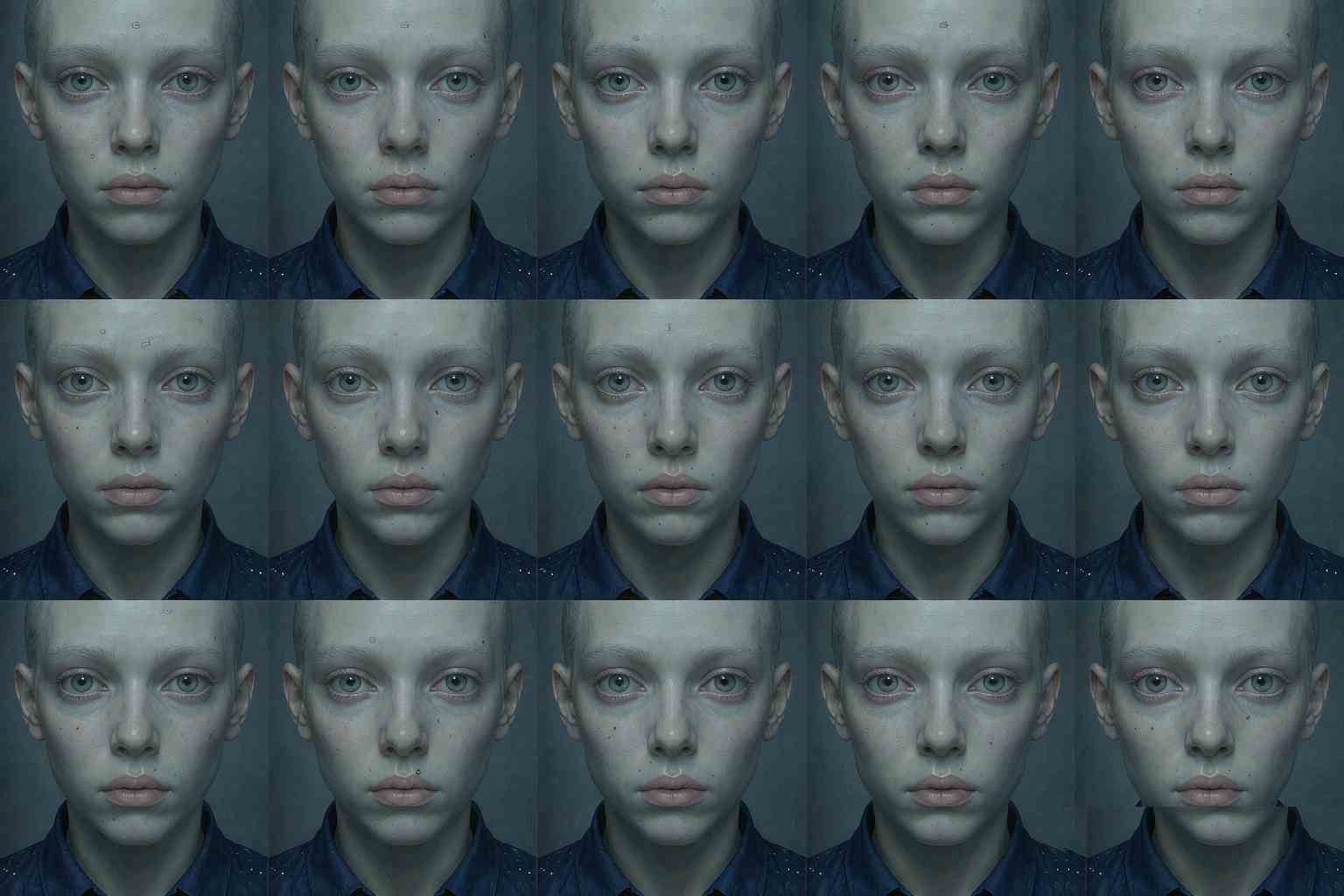
There is an evolutionary argument hiding in here too. Humans are wired to read faces for identity and emotion, and we depend on small differences to tell people apart. A standardized face with no distinguishing marks trips the same alarm as the uncanny valley: it is close enough to human to register as a face, but different enough to feel wrong. The disgust is not snobbery. It is a perceptual response to a thing that looks almost human but is not quite.
The same dynamic plays out in how the model treats identity itself. An AI "actor" is a statistical fit over a distribution of expressions, not a person with an autonomic nervous system. Real faces move because of physiology and situation; a tired person's brow relaxes a certain way, a genuinely amused person crinkles their eyes. The model can approximate these, but it cannot originate them, and the difference shows up as a subtle flatness that viewers register even when they cannot name it. It is the difference between a performance and a rendering.
There is a concrete data point that shows how far the homogenization has gone. Reports describe training material packs containing tens of thousands of short-drama clips, allegedly scraped without permission, selling for under a dollar. When the training data is that narrow and reused that widely, the faces it produces cannot help but converge. The sameness is not an accident of taste. It is a downstream consequence of a supply chain optimized for cheap volume.
This is not just an aesthetic complaint. It is becoming a commercial one. When every show looks like the same show, nothing is memorable, and a category that lives on novelty dies on sameness. The Chinese regulator is already drafting a quality standard that makes character distinctiveness its own scoring item, which is a clear signal about where the industry expects the next wave of competition to be. A category that cannot tell its own characters apart is a category that has not figured out why anyone should keep watching.
There is a deeper point underneath all of this that applies far beyond short dramas. Generative AI tends toward the average because the average is the safest bet, and the safest bet is what a probability model is trained to make. Human creativity tends toward the specific because a specific choice is the only thing that stands out. The fight between the two is now playing out in real time, on a massive scale, in a corner of the internet most Western observers are not watching.
The reason this matters beyond aesthetics is that it previews a bigger cultural question. If the cheapest and easiest content all converges on the same look, the same face, the same voice, then the internet becomes a hall of mirrors reflecting one statistical average back at itself. The people fighting that convergence, the ones insisting on a crooked nose, a dialect, an unplanned pause, are not being nostalgic. They are defending the thing that makes culture worth having at all.
The parallel with the wider AI slop problem is exact. Deezer reports 75,000 AI songs uploaded a day. An audit of American newspapers found 9 percent of new articles flagged as AI-generated. The common thread is that generative tools, run without editorial intent, produce a flood of competent but interchangeable output. The AI face is just the most visually jarring example of a phenomenon that is reshaping music, text, and images at the same time.
The fix is not to make the models less smooth. It is to stop treating the model's default as the finished product. Character distinctiveness has to be designed for, deliberately, the same way a casting director designs a cast. The tools already support it, reference images, keyframes, locked features. What is missing is the will to spend the extra time, because the economics of the boom reward speed. The creators who resist the average face are the ones who will still have an audience when the novelty wears off. That is the bet, and it is the same bet every maturing medium forces on its creators: be specific, or disappear into the average.
There is a reason to think the pressure is already shifting. The platforms that fueled the boom by rewarding volume are now starting to reward distinctiveness, because a feed full of interchangeable faces is a retention problem. The quality standard is one lever; the algorithm is another. Once the platform stops rewarding sameness, the economics flip, and the teams that built the muscle for character design will be the ones positioned to win. The AI face is not going away. What is going away is the idea that you can win with the default, and that is a healthy development for everyone who actually wants to make something worth watching.
Related articles
From Fifteen-Second Clips to Five-Minute Films: the Solo Creator Becomes a Studio
The pitch moved from a prettier clip to a finished piece. AI video's real market may not be short dramas at all, but e-commerce videos with a measurable return.
The AI Slop Economy: 75,000 Songs a Day and the Age of Perfectly Average Content
AI made production nearly free, and the internet filled with content that is fine but forgettable. The scarce resource now is a reason for content to exist.
China's AI Drama Boom: 430,000 Short Dramas in Eight Months, 90% Made by Machines
A category that barely existed two years ago is now an industrial pipeline. AI video moved from demos to a monetized business, and it happened first in China.
From AI Slop to Native Transparency: A Year of Image Generation, in Four Shifts
Image generation grew up this year. The move from finished pictures to composable assets is the milestone most people missed.