
The Used 3090 Video Rig: What Local Generation Actually Costs in 2026
The shopping list people are actually posting
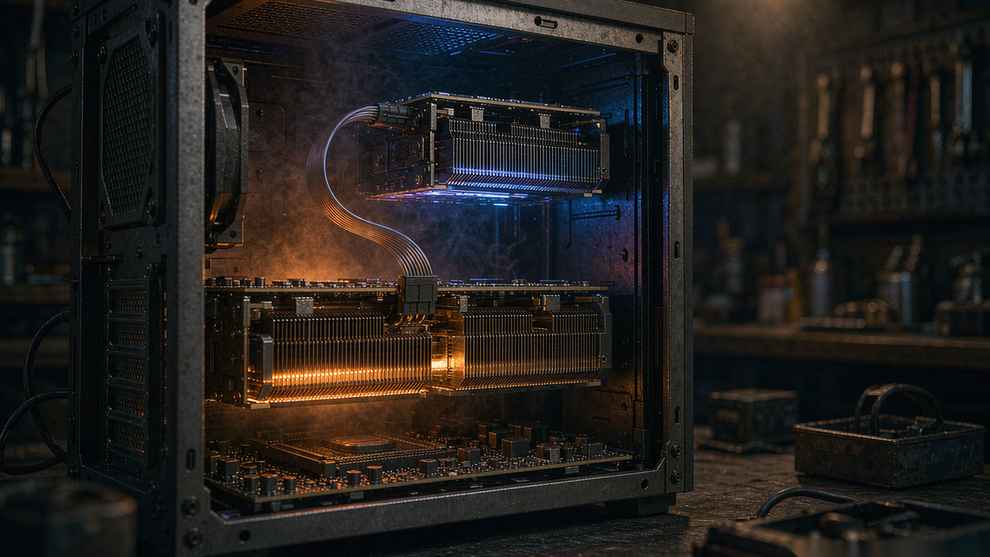
In early October, someone on r/LocalLLM posted a build list for a budget local AI video server and asked for advice. The parts: an RTX 3090 with 24GB, an RTX 3060 with 12GB, a Huananzhi X99 board, a Xeon E5-2699 v3, 32GB of DDR4, a 1TB NVMe drive. The goal was modest and specific, text-to-video and image-to-video at 720p or 1080p, realistic, without paying per generation.
Threads like this have become the most honest reporting on local AI. Not because the hardware is impressive, but because the constraints are stated. Nobody in that thread is claiming they will match a hosted model. They are trying to find out where the wall is, and the wall turns out to be in a place most people do not expect.
It is not model quality. It is scheduling.
What 24GB buys, and what the second card is for
Video generation is memory-hungry in a way image generation is not. A single 24GB card is the practical floor for local video work at usable resolutions, and the 3090 remains the value pick because it has the memory bandwidth of a much more expensive card. That is why it keeps showing up in these builds years after launch.
The 12GB card is the part people underestimate. It is not there to render video alongside the 3090. It is there to hold everything else (the language model that rewrites prompts, the upscaler, the captioning model, the audio pass), so the 3090 does not have to swap models in and out every time the workflow changes hands.
That is a scheduling problem, and it is being solved in public. Another r/LocalLLM post from mid-October showed an open-source GPU orchestrator that loads and unloads models on demand so llama.cpp, Ollama, ComfyUI, and a TTS engine can share one GPU. The comments immediately compared it to llama-swap, which starts and terminates applications and lets you define groups that can coexist. Someone else pointed at their own homegrown version. This is what a maturing ecosystem looks like: people are no longer arguing about which model is best, they are arguing about which process gets the card at 2am.
The same pressure shows up in the app layer. On r/StableDiffusion, a developer introduced a native macOS app built on a custom inference engine tuned for Apple Silicon, pitched at people who are tired of wiring node graphs by hand. On r/DGX_Spark, someone assembled a workspace that runs seven models simultaneously on one Spark, chat, OCR, speech recognition, translation, image generation, video with sound, and music, behind a single web interface. Different hardware, same instinct: stop treating each model as its own application.
The awkward math of iteration
Here is the thing the build lists do not capture. Local video generation is not one render. It is twenty renders, because the first nineteen will have a hand that melts or a camera that drifts.
A hosted model at a few cents a clip makes that loop cheap and fast. A local rig at three to six minutes per attempt makes it slow, and slow loops change how you work: you stop exploring, you accept the third take, you write prompts you know will work instead of prompts you want to try.
That trade is not automatically bad. If you are generating hundreds of clips a month, the local rig pays for itself and the queue becomes your bottleneck instead of your budget. If you are generating ten, you are paying for a hobby with a power bill.
The break-even is not really about money. It is about whether you value privacy and unlimited retries more than you value the speed of finding out that an idea was bad.
The editing layer is catching up
One more piece arrived in late September: an open-source, extensible video editor and generator built specifically for AI compositing, which picked up over a thousand upvotes on r/StableDiffusion in a day. The pitch is not "generate better clips." It is "put the clips you generated somewhere they can be fixed."
That is the missing middle in every local workflow. Generation gets the attention, but the reason a finished video looks finished is the timeline: trimming the half-second where the face changes, layering a real background behind a generated foreground, adding the sound that makes a cut feel intentional. Local generation without a local timeline is a folder full of clips.
The pattern across all of these projects is the same, and it is worth naming. The local stack is being assembled into an appliance. One box, one interface, a scheduler that decides which model gets the GPU, and an editor at the end that treats generated footage as footage rather than as output.
What to actually expect
If you are considering a build like the one in that thread, three expectations are worth calibrating.
720p is the honest target. 1080p local video exists, but it is where the time per clip stops being measured in minutes and starts being measured in coffee. The people posting successful local video work are mostly at 720p with a good upscale.
The memory floor is higher than the model card says. TRELLIS.2, Microsoft's 4B image-to-3D model, asks for at least 24GB and was verified on A100 and H100 hardware. That is a research model, but the direction is clear: anything that generates structured 3D or long video wants memory you probably do not have yet.
The software is the hard part. Drivers, CUDA versions, node packs that do not agree with each other, a Windows security feature that blocks an unsigned native module. A weekend of driver work per quarter is not unusual, and it is the reason pre-built appliances keep selling.
Why this matters beyond hobbyists
The signal that matters in these threads is not that people are running video models in their spare room. It is that the constraint has moved from "can it generate" to "can I keep the pipeline fed." That is what happens when a technology stops being a demo.
Cloud will stay better for a while at the high end, the frontier models are not going to run on a used 3090, and the difference shows in faces and physics. But the middle of the market, where a small studio needs a hundred clips a month with no per-generation bill and no upload of client footage, is exactly where a 24GB card, a scheduler, and an editor start to look less like a hobby and more like infrastructure.
The build lists are unglamorous. They are also the most accurate map of where the technology actually is.
Related articles
The Three Giveaways of AI-Made Work: Four Pixels Off, an Invisible Stamp, and Nobody's Name
A diagram project's 4px rule, SynthID's invisible stamp and the Nikon scandal, and the publishers using AI without telling authors: three layers of “AI-ness,” only two of which technology can patch.
CLI-Anything Gives Desktop Software a Command Line So Agents Can Use It
Instead of teaching agents to click, HKU's lab generates Click-based CLIs from application source code, with tests, JSON output, and a package you pip install. Real backends, real renders, honest limits.
CLI-Anything Gives Desktop Software a Command Line So Agents Can Use It
Instead of teaching agents to click, HKU's lab generates Click-based CLIs from application source code, with tests, JSON output, and a package you pip install. Real backends, real renders, honest limits.
XERJ Searches Your Code So Agents Stop Reading Whole Files
A Rust search engine with autoindex, tree-sitter symbol awareness, and an Elasticsearch-compatible wire protocol. Its benchmark says 2.7x fewer tokens than grep. Its maintainer says the star count is inflated 13x.