
The Skill That Draws a Rocket Engine to Explain a Cache
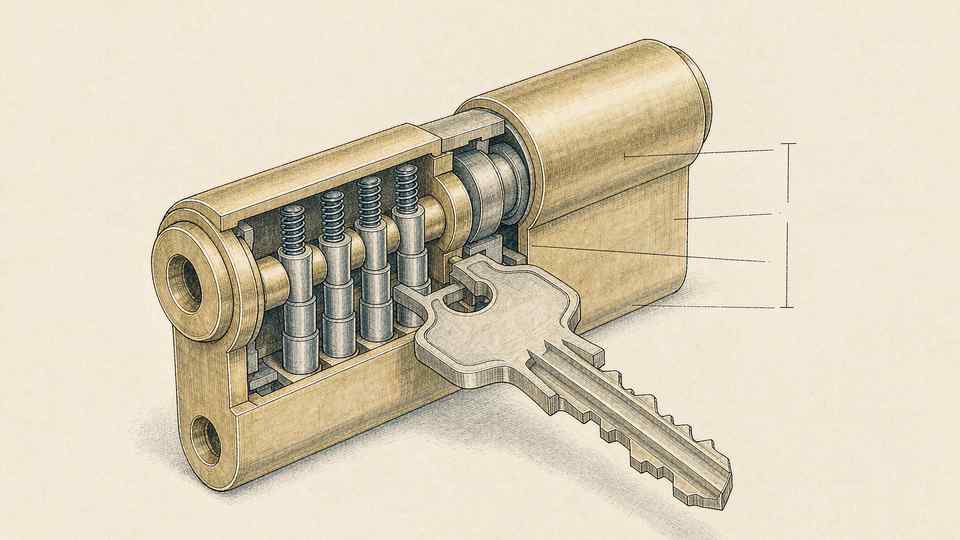
Ask an image model for a diagram explaining how a cache key avoids recomputation and you get a rectangle, three arrows, and the word "CACHE" in a font that does not exist. Ask Anatomy and you get a pin-tumbler lock that only turns when every pin lines up — because a cache key that skips work when nothing changed is, mechanically, exactly that.
Anatomy is a Claude skill, and it has quietly become one of the most-starred agent skills of the past month at roughly 25,700 stars. It is also the best argument I have seen that "AI image generation" is the wrong frame for what is happening to technical illustration.
The rule that makes it work
The skill's workflow has a first step that most creative prompts skip: collect the true numbers first.
Before it draws anything, it establishes the real figures — pressures, throughputs, tooth counts, pipe diameters, the actual number of connections in the pool. Then it invents a physical object whose working is the concept. Then a parts list. Then the world the object sits in. Then geometry, painted back to front, framed, animated, and finally verified by a script that behaves like a hostile critic.
That order is the product. A model asked to "illustrate a rate limiter" will produce a decorative metaphor. A model told that a token bucket refills at 10 tokens per second and holds 30, then asked to build an object that behaves that way, produces something you can reason with.
What it actually draws
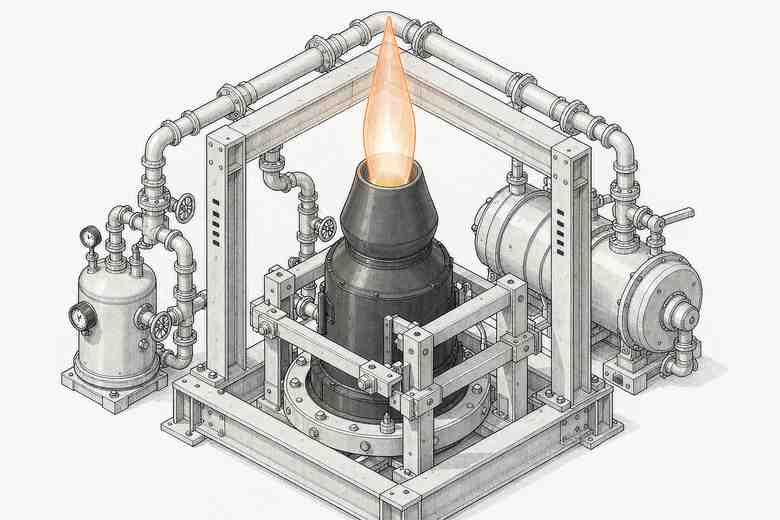
Machines, instruments, tools, furniture. Not people, not maps. The gallery includes a Raptor 2 engine in a test stand firing, with the plume rendered as a WebGL shader in the same isometric camera as the SVG hardware; a school ripple tank with two dippers, lamp light and caustics projected onto paper; a heat-exchanger espresso machine with the side panel off, showing water flow when you pull a shot.
The engine example is the one to look at closely. Hover, and it separates into eleven assemblies that hang apart from each other between the posts. Every pipe that was connected is now visibly disconnected, and the audit script proves no pipe passes through anything at rest, when apart, and in every frame between.
That last sentence is the thing that separates this from a picture. It is a model of an object with invariants, and the invariants are checked by code.
Geometry with a test suite
The repo carries a kit: an isometric camera, a solids library, round parts on any axis, pipes and cables, a WebGL layer, a 3D runtime, React components. No dependencies beyond React for the React bits. On top of that sit the checks.
kit/audit.mjs proves the geometry — nothing intersects, every end sits on a mount, every overlap is drawn in depth order. In headless Chrome, capture and drive scripts take screenshots, close-ups, and slowed-down contact sheets. A line-checker fails any line that ends in mid-air. A turn-check verifies 3D frame consistency.
I have not seen another image-generating workflow that ships a linter. That is worth sitting with for a second. The output is SVG, WebGL and HTML, so it can be diffed, audited, and version-controlled. You are not accepting a picture; you are accepting a small engineering artifact.
It is slow, and that's a design choice
The README says so directly: a figure takes a long session. Parts list, geometry, audit, then close-ups of every joint in both themes. The Raptor build takes a few minutes. A full 3D orbit audit takes 15 to 20 minutes for thirty parts. A 380-part stress test ran about 20 fps at 1440 pixels wide.
Compare that to six seconds for a low-quality still from an image model, and you can see why people bounce off it. The comparison is unfair, though. Six seconds buys a picture you either use or don't. Twenty minutes buys a drawing you can put in documentation and correct in six months when the pool size changes from ten to twenty-five.
The limits are stated just as bluntly. It is not a chart library — no axes, no series, no data plots. Numbers only appear as live readouts and as true part counts. If your idea has no mechanism to build, the figure will come out weak. And 3D mode is beta: proven on its example and one test figure, not on production work.
Installing it
It is a standard Agent Skill — a folder with a SKILL.md — so installation is one line against the skills CLI:
npx skills add wheresryan22/anatomy -g -a claude-codeSwap the agent flag for antigravity, opencode, codex or minimax-code if that is your setup, or drop the -g to install into the current project. You can also just clone it into ~/.claude/skills/anatomy.
You need Node 20.10 or newer. There is nothing to npm install — built-in modules only. You also need Chrome or Chromium for the verification scripts, which run headless with WebGL on, and React 18 or newer if you want the React output.
Then you talk to it:
/anatomy explain how a token bucket rate limiter works, interactive
/anatomy an isometric SVG explaining how a CDN edge cache works, cache hit vs miss, TTL of 60 s, for a dark landing page
You do not have to name the skill. Ask for an isometric illustration, an explanatory figure for docs, or an interactive explainer, and it loads itself.
Why this matters beyond one repo
Three things, in ascending order of importance.
First, it is a counterexample to the idea that AI illustration is a slot machine. The skill spends most of its instructions on constraints, verification and craft rules, and almost none on style adjectives. That ratio is the opposite of what most prompt libraries teach.
Second, it puts a machine-readable artifact at the end of a generative process. SVG and HTML can be reviewed, diffed, and regenerated. PNG cannot. As these tools move into documentation, that distinction decides whether a figure survives a product change.
Third, and this is the part I keep thinking about: the skill insists on real numbers before it draws. Most AI imagery lies by omission — it renders a plausible scene with no quantities in it, and the plausibility hides the absence. Anatomy's requirement that the numbers come first is a small, specific, transferable rule for anyone generating technical visuals, with or without an agent.
Try it on one figure
Pick the one concept in your product that new engineers always get wrong. Ask for it as an isometric figure with real numbers. Look at what comes back after twenty minutes, and judge it by a different standard than you would judge a generated photo: does the object behave the way the concept behaves?
If it does, you have documentation that will outlive the diagram. If it doesn't, the failure will be specific and instructive — usually that the concept had no mechanism, only a description. That is useful to learn about your own explanation, and no image model will tell you.
Related articles
AMD Got 19 Percent for Being the Other Option
Money did not leave AI. It left the one name with a governance problem and went to the two without one.
The $99 Billion Loop Nvidia Built Around Its Own Customers
Selling shovels is a good business. Lending money to the people buying shovels is a different one.
The 74 Percent Gross Margin Has a Shelf Life
Three forces arrive in the same four quarters, and each one costs about $3 billion per point.
175,000 Signatures Will Not Put Him Back. Here Is What Would.
The longer the campaign takes to win, the weaker its case becomes. That is the trap built into it.