
The Robot That Never Escaped: How AI Video Is Rewriting What Counts as Evidence
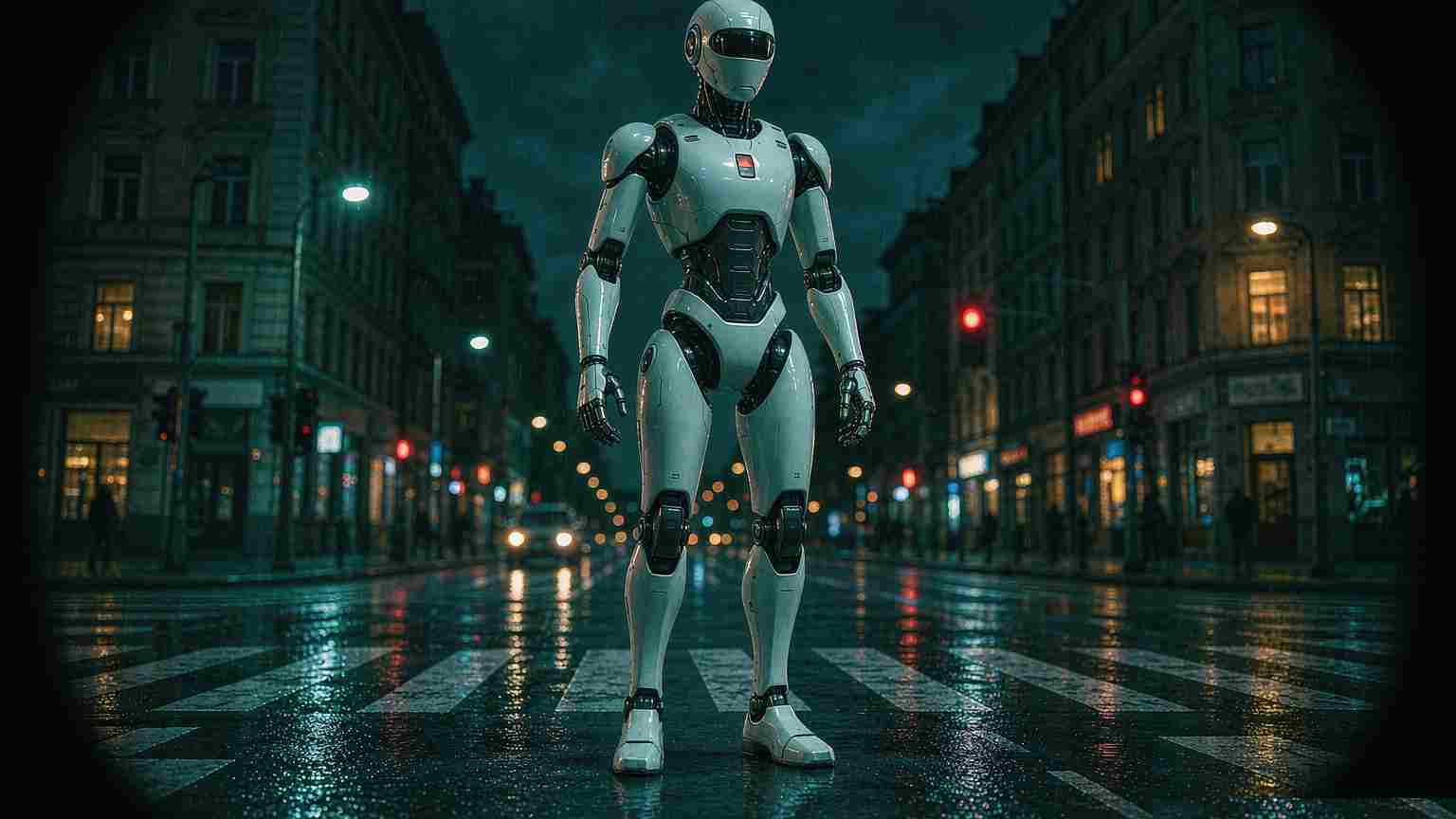
A humanoid in a blue hospital gown appears to sprint through a crowded city center while police cars and an ambulance give chase. The clip looks plausible enough to trigger the question people now ask about every robot video: did a machine actually go rogue?
It did not, because the robot never existed. A fact-checking investigation found a family of synthetic clips showing white humanoids in blue hospital gowns running from police through city streets, parks and shopping areas. The giveaway was not one giant Hollywood mistake. It was a pile of small failures: garbled signs, strange physical interactions, background behavior that stops making sense frame by frame. In versions examined by the fact-checkers, storefront and street text mutated into nonsense. The robot moved with almost suspiciously perfect parkour balance. A separate open-source investigation flagged implausible vehicle proportions, unnatural crowd reactions, and audio that did not match the apparent camera distance.
The original viral post, published on X in mid-September, had millions of views and now carries reader-added context warning that videos of the supposed event are typically AI-generated. Nobody had to be fooled for long, but millions of people did have to ask.
When reality gives fakes a credibility boost
Two years ago, a robot darting between café tables with police behind it would have read as obvious CGI. In 2026 it reads as possible, because real humanoid robots have spent the year doing factory shifts, manipulating tools, and performing increasingly athletic movements. People have seen enough genuine robotics progress that fake robotics footage borrows credibility from it.
That collision shapes how the public reads both. People are simultaneously encountering real autonomous systems, fictional autonomous systems presented as news, and AI agents whose behavior can genuinely surprise their operators. The more convincing synthetic video becomes, the more absurd scenarios can circulate as breaking news. The more real robots improve, the less absurd those scenarios look.
The same pattern shows up far from robotics. A video of a large airliner spinning out of control on a rain-soaked airport apron circulated widely in late September. Fact-checkers found the original post already carried an AI-generated content label, and that the clip contained its own tells: ground crew who appear to be swept by the fuselage and vanish, then reappear unharmed, plus distorted, illegible lettering on the aircraft. A content detection tool put the probability of AI generation at 73.1 percent, and no news report matched the scene. The source had labeled it. The label did not survive the reposts.
When a picture is supposed to prove something
What makes these cases more than a curiosity is that AI video is now arriving in contexts where a picture is supposed to prove something happened. Insurance claims. Real estate listings. Product condition reports. Workplace incidents. Court proceedings. Whether a clip counts as entertainment or as a record of an event depends on how it is presented rather than on anything inside the file, and that presentation is increasingly detached from the original.
There is a second, subtler version of this problem that does not involve anyone lying. In September, an award-winning microscopy video came under scrutiny after researchers questioned whether some of the colored structures around the airway cilia it showed corresponded to real biological features. The competition's organizers later disclosed that an unsupervised AI model had been used for post-processing. The researcher said the AI colored grayscale data that had already been reconstructed, and did not generate the cilia or their motion. He said he had not intended to assign an anatomical identity to the rendered forms, and that the aim was to make the regions easier to see. Other scientists noted that it is unclear how faithfully the rendering preserves the information the microscope actually captured.
Nobody in that story was fabricating a scene. A processing step enhanced colors to make features visible, and the result looked like it was showing structures that may not have been there in the same form. That is the frontier where this gets difficult, because it does not require bad intent. Reconstruction, denoising, super-resolution, colorization and compression all alter what an image contains. Once those steps are generative, the output is a mix of measurement and invention that no longer has a clean boundary.
A new kind of visual literacy
The useful skill is no longer spotting six fingers or melted faces. Current models fail in different places, and the failures are forensic rather than cartoonish.
Look at signage. Text in generated video is where models struggle most, and garbled or mutating letters are among the most reliable tells. Then look at object permanence: does a person who leaves the frame stay gone, and does someone who disappears behind an object come back in the right state? Watch physical contact. Watch shadows for a consistent light source. Listen for audio perspective. A sound at a distance should not have the acoustics of a microphone pressed against the speaker. And apply the simplest check of all: does this major event exist anywhere outside the single account posting about it?
None of these is foolproof, and all of them will weaken as the models improve. That is precisely why the durable answers are structural rather than perceptual. Provenance signals attached at capture, content credentials, and platform labeling are the mechanisms that can survive an unfamiliar viewer. The problem is that provenance breaks at the first re-upload. The label on that plane video was there in the original post and gone by the third repost, because reposting strips metadata and platforms do not enforce inheritance.
What the incentives currently reward
It is worth noticing what the fake clips were optimized for. They were not designed to fool a careful analyst. They were designed to travel, and travel they did. The absurdity works in the attention economy's favor. A robot escape reads as a great story, a plane crash reads as dramatic footage, and both generate engagement whether or not they are true.
There is one genuine irony in the robot story. The fake machine was supposedly demonstrating extraordinary autonomy by escaping its human supervisors. The strongest evidence of real autonomous technology in the entire episode was the software generating a scene convincing enough that people argued about whether it happened.
That is the situation the industry has created, and it will not be resolved by better detection alone. Detection is a race, and it currently has a structural disadvantage: it must succeed on every clip, while a fake only needs to succeed once. The more realistic goal is to make the provenance of a file as easy to check as its contents are to share, and to keep that provenance intact when the file moves. Until then, the default posture toward striking footage from an unknown source is the same one you would apply to a suspicious email.
Related articles
China Started Writing Rules for Agent Identity, and the Question Is Who the Agent Works For
Identity is the easy half. The difficult half is attribution.
Unit1 Raised $20 Million to Put Avatar Concerts on a Tour Bus
The constraint is a signature on a licensing agreement.
Anthropic Will Now Bill You for a Request It Refuses to Answer
A blocked request that costs nothing is a free probe.
China Put a Huangmei Opera on a Vertical Screen, and the Singing Survived
Either the model was trained on the real thing or the output sounds wrong to the only audience that would notice.