
The IDE for Artists: ArtCraft Puts Blocking and Cameras Back Before the Prompt
The tool that showed up at the top of GitHub this month is not a model
For most of the past two years, the way you got a specific image out of an AI system was to describe it better. You learned the vocabulary, golden hour, 35mm, shallow depth of field, three-quarter view, and you kept rolling until something landed. People call it prompt roulette because that is what it is: a slot machine with a text field.
ArtCraft, a Rust desktop application that sat at the top of GitHub's weekly trending board in early October, is an argument that the missing piece was never a better prompt. It was a place to make decisions before the sampling starts. The project calls itself an intentional crafting engine for artists, designers, and filmmakers. The shorter version, from its own README, is that it wants to be the IDE for people who make pictures and shots.
That framing is doing real work. An IDE does not write your program. It gives you a place to see structure, move pieces around, and check what you built before you run it. ArtCraft applies the same idea to a frame.
What it actually does
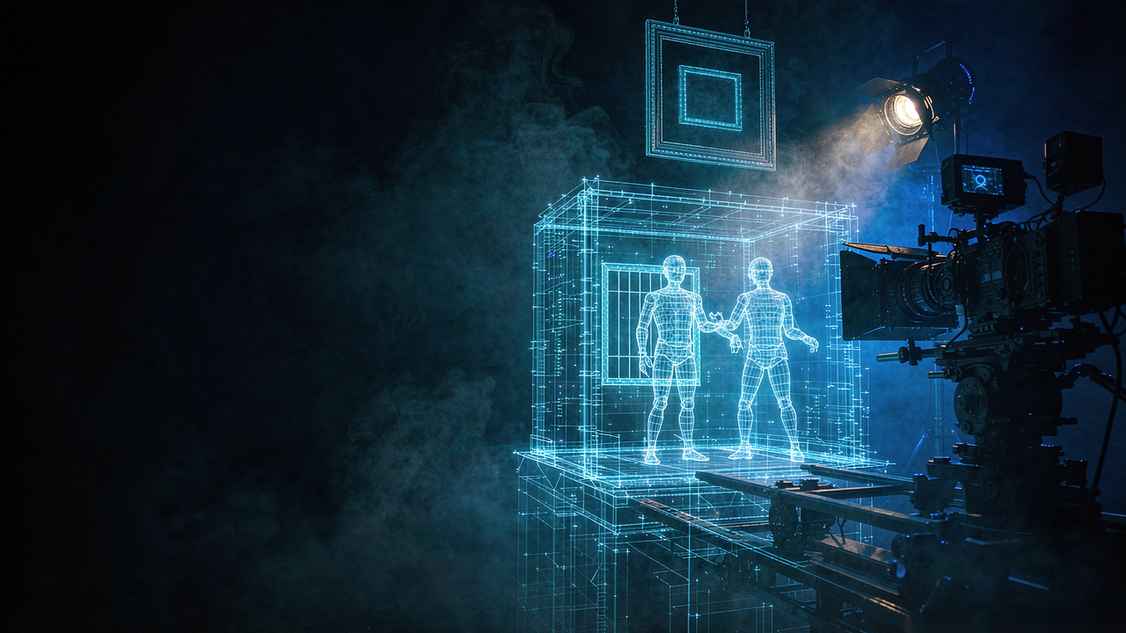
Open a project and you get two spaces at once. One is a 2D canvas: layers, background removal, drawing tools, masks, inpainting. The other is a 3D scene where you place backdrops, props, and meshes converted from images, pose a mannequin, and set camera angles.
The features that matter most are the ones that keep a shot consistent:
Image to Location. You place virtual actors inside a set once, and the set persists across shots. If you are planning five frames in the same room, the room does not get re-invented between frames.
Character posing and identity transfer. The mannequin is, in the project's own description, a simple 3D ControlNet. You rotate a joint instead of writing "her left hand resting on the table, elbow at roughly ninety degrees" and hoping.
3D compositing and kitbashing. Backdrops and props layer with actual depth, so a foreground element and a background element can be blocked against each other instead of being flattened into one prompt.
Image to 3D mesh. A picture becomes an object you can rotate and frame, which is the difference between "a chair in the corner" and a chair at a specific distance from the lens.
Generation itself is pluggable. The app routes to third-party models rather than shipping one: text-to-image across a dozen options, prompted editing including Google's Nano Banana line and OpenAI's image models, and image-to-video through services like Seedance and Kling. Sets can also be built from Gaussian splats made with World Labs' Marble. That last detail tells you who this is for. Someone capturing a real room and then shooting inside it is not making a meme.
Why this is an editing thesis, not a model thesis
ArtCraft matters because it improves output quality without improving a model. Every gain comes from moving a decision earlier, into a place where it can be seen and changed.
That is the opposite of how most AI creative tools are built. They put the model in the center and the interface around it, which means the interface can only ever negotiate with a result that already exists. ArtCraft puts the scene in the center and treats models as renderers. The mental model is closer to a stage than to a chat window.
There is a practical consequence. When composition lives in a scene file, it can be versioned, reused, and handed to someone else. When it lives in a prompt, it dies with the session. Anyone who has spent an afternoon getting a character to look right in shot four, then discovered shot five has a different nose, understands the difference.
The project's founder, Brandon Thomas, presented it on Hacker News in February 2026 as an AI movie making and design engine he had built for himself and for other filmmakers. That origin explains the priorities. The features are the ones a person shooting a short film would ask for, not the ones a person making a single wallpaper would ask for.
The parts worth being careful about
Three caveats, and they are not small.
The license is a mess. GitHub reports the repository license as "Other," which is GitHub's way of saying it could not classify it. At least one project page describes the code as dual-licensed MIT or Apache-2.0. Those are not the same claim, and the difference matters if you plan to build a commercial pipeline on it. Read the LICENSE file in the repository before you ship anything.
The hardware story is undocumented. The documentation covers installing and installing from source. It is much quieter about GPU and VRAM requirements, where the generation weights come from, and whether inference runs locally or through a hosted service. Given that the app is credits-based, monthly plans or one-time packs, with the option to bring your own compute or your own model subscriptions, the answer is probably "it depends on which backend you pick." Confirm that before you plan a workstation around it.
A desktop studio is a lot of tool. If what you want is one good image for a blog post, this is more software than the job needs. ArtCraft is for people with a sequence in mind: multiple shots, one location, one character, a camera that has to stay on the same side of the line.
What the star count is telling us
The repository picked up somewhere north of two thousand stars in a single day in early October and has been sitting in the seven-thousand range since, with fork counts high enough to suggest people are pulling the code down rather than bookmarking it. It was also built over a long stretch, the project has been shipping since 2022 in one form or another, which is unusual for something that suddenly trends.
That combination is unusual. Trending boards are usually full of new things. This was an old thing that became newly relevant, which tends to mean the surrounding ecosystem finally caught up to the idea. Image models got good enough that the bottleneck moved. It is no longer "can it render a believable person." It is "can I put that person where I want, twice, from two angles, with the light still matching."
ArtCraft's answer is to stop asking a language model to be a stage manager. Build the stage, then render it. It is a less exciting pitch than a new model with a bigger benchmark number, and it is probably the more useful one for anyone who has to deliver a second frame that matches the first.
Related articles
The Three Giveaways of AI-Made Work: Four Pixels Off, an Invisible Stamp, and Nobody's Name
A diagram project's 4px rule, SynthID's invisible stamp and the Nikon scandal, and the publishers using AI without telling authors: three layers of “AI-ness,” only two of which technology can patch.
CLI-Anything Gives Desktop Software a Command Line So Agents Can Use It
Instead of teaching agents to click, HKU's lab generates Click-based CLIs from application source code, with tests, JSON output, and a package you pip install. Real backends, real renders, honest limits.
CLI-Anything Gives Desktop Software a Command Line So Agents Can Use It
Instead of teaching agents to click, HKU's lab generates Click-based CLIs from application source code, with tests, JSON output, and a package you pip install. Real backends, real renders, honest limits.
XERJ Searches Your Code So Agents Stop Reading Whole Files
A Rust search engine with autoindex, tree-sitter symbol awareness, and an Elasticsearch-compatible wire protocol. Its benchmark says 2.7x fewer tokens than grep. Its maintainer says the star count is inflated 13x.