
Runway's Praxis-1 Bet: Video Pretraining as the Shortcut to Robot Brains
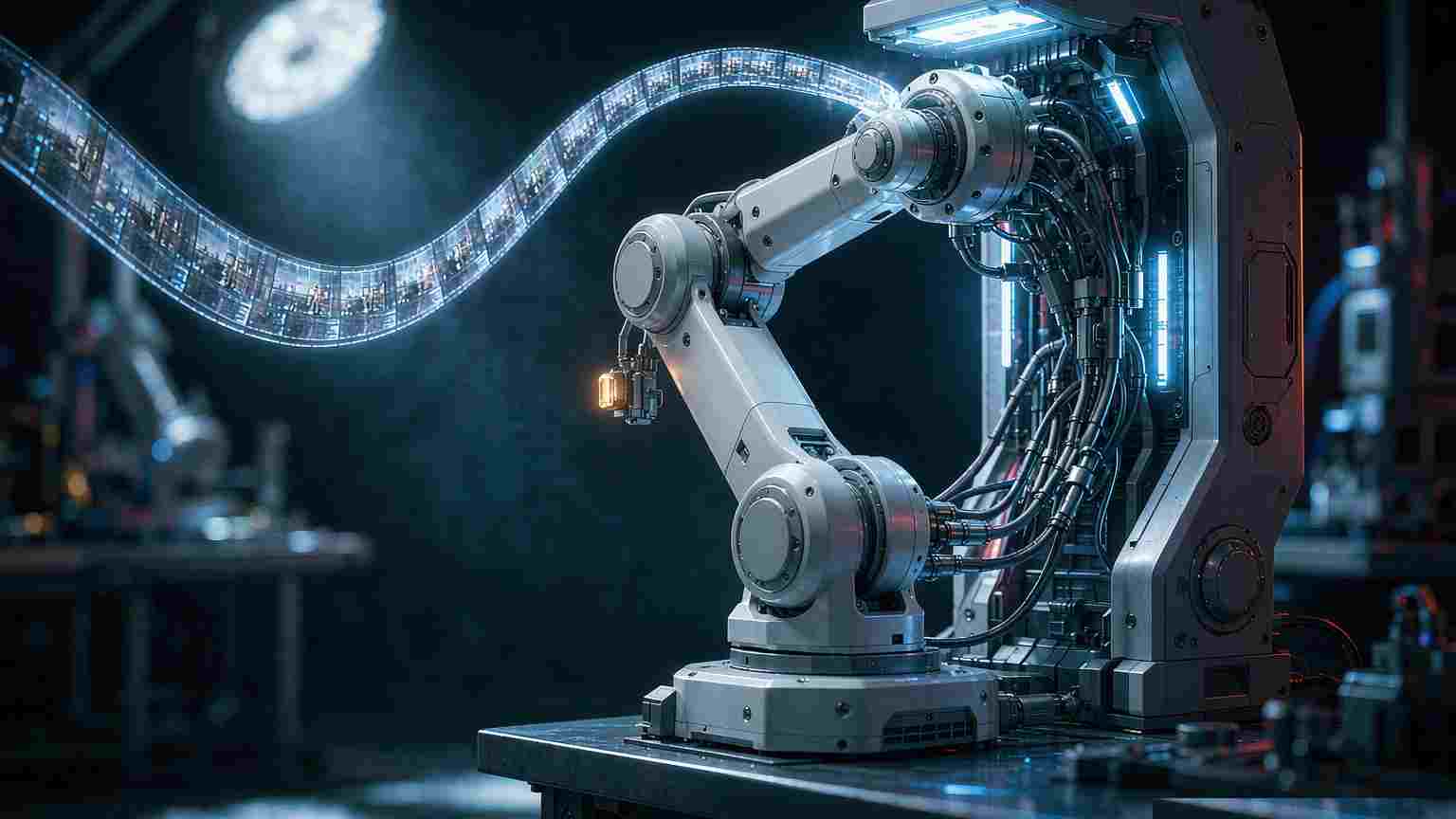
Every robotics program with serious deployment ambitions runs into the same wall, and it is not a hardware wall. Real-world data is scarce and expensive to collect at the volume a generalist policy needs. For domains full of edge cases, including autonomous driving, household robotics and warehouse work in messy environments, there is no practical way to gather the demonstrations required to train a model that can handle what will actually happen.
Runway announced Praxis-1 on September 30, and its argument begins with that wall. Praxis-1 is an open-weight world action model that converts Runway's large-scale video pretraining into control policies for real robots. The company is testing it with early partners Noble Machines, Standard Bots and Ultra, each running the model on its own hardware, with a public release under open weights planned for the coming months.
Video as the substitute for teleoperation
The premise is straightforward once stated. Video is effectively limitless, and it is becoming more so as generative models reach parity with real footage on quality and speed. People film and upload more of everyday life each day than any robotics lab could capture through teleoperated demonstrations. If a model can learn the structure of the physical world from that footage, the bottleneck moves from scarce robot data to abundant general video.
The claim that gives this weight is empirical. Runway reports that simulating robot policies inside its world model predicts real-world results with 0.95 correlation, comparing favorably to more expensive 3D reconstruction-based techniques. A world model that can be used as a faithful test environment changes the economics of policy development, because evaluation stops requiring physical hardware for every iteration.
The company also found that policy performance improves as third-person video scale increases, and draws the conclusion that the bottleneck on a capable policy becomes how much general video a model can train on. That is the same scaling argument that drove language models, applied to motor control. A policy that already understands physical plausibility and object behavior from video pretraining starts from a much stronger position than one built from action data alone.
The architecture behind the bet
Praxis-1 is built on the same video pretraining that produced Runway's general world models and its interactive, real-time work such as Solaris and the GWM Worlds line. The logic of that lineage matters. Teaching a model how objects behave, how hands move, and what a task looks like partway through creates dynamic environments for training agents in both digital and physical settings.
Runway frames this as a compounding advantage. The more the model understands about how the world works from video, the better it can control a robot in environments that differ from anything it saw in training. The stated goal is a generalist policy model for robotics developers and researchers that works across any embodiment or environment, rather than a policy tuned to one arm or one gripper.
That ambition is where the skeptical reading comes in. "Works across any embodiment" is a strong claim, and the evidence so far comes from three named partners running the model on their own hardware, ahead of a wider launch. The correlation figure of 0.95 is measured between simulation inside Runway's world model and real-world results, which is a validation of the simulator as much as of the policy. Both are useful, and both are Runway's own numbers at this stage.
Why open weights, and why it is a strategic argument
Runway is shipping Praxis-1 with open weights rather than as a closed model, and the reasoning is unusually explicit for a company that has kept most of its models proprietary. The announcement frames it as a matter of US competitiveness in physical AI: regaining leadership in manufacturing, accelerating productivity, and securing allies will require, in Runway's words, a level of interoperability and openness from American models that does not currently exist for physical use cases.
That is a policy-flavored argument, and it lands in the middle of an active debate about how much of the AI stack should be open. For robotics specifically, the case for open weights is stronger than for frontier language models. Hardware developers need to run policies on their own machines, with their own sensors and actuators, and a cloud API that requires sending those signals away is a poor fit. Open world models give hardware makers flexibility and control they cannot get from a hosted model.
There is also a competitive dimension the announcement does not state outright. Much of the momentum in open-weight video and world models has come from Chinese labs. A prominent US company shipping open weights in the same category reads partly as an attempt to define the ecosystem's center of gravity before someone else does.
A correlation of 0.95 is a strong number and it deserves a translation. It means that when Runway runs a candidate policy inside its world model and measures how it performs, the real robot performs almost the same way. If that holds across tasks, the practical consequence is that a robotics team can run the bulk of its experiments in simulation and reserve physical hardware for the final check. Given how expensive and slow physical trials are, that is the difference between running a hundred iterations in a week and running a handful in a month.
The harder question is generalization. Video teaches a model what the world looks like and how objects tend to behave, but a robot also needs to know what to do with a specific arm, on a specific task, with a specific tolerance for failure. Runway's argument is that the video-trained prior reduces how much task-specific data is needed to get there. That is plausible, and unproven at scale.
Where this fits in the wider robotics race
Praxis-1 arrives in a year when humanoid and manufacturing robotics have moved from demos toward deployments. Figure has been training retired humanoids for extreme tasks. Humanoid makers have been signing factory pilots with automakers, and Boston Dynamics has begun testing its Atlas robot inside a Hyundai facility with plans for large-scale deployment by 2030. The common thread is that capability is improving faster than the data pipeline that feeds it.
Runway's contribution is to argue that the data pipeline problem has a shortcut, and that the shortcut runs through video. If the correlation between simulated and real results holds up across partners and tasks, the practical effect is that robotics teams can iterate in a world model, reserve physical testing for final validation, and learn from a category of data that keeps growing on its own.
That is a meaningful claim and an unproven one. The company is providing pre-launch access to select partners and inviting researchers to test it on their own hardware. The evidence that matters will not be the correlation figure from Runway's internal work. It will be whether independent labs reproduce the result, and whether a policy trained largely on third-person internet video handles a task it has never seen in a room it has never been in. That is the test that decides whether video pretraining becomes the default foundation for robot brains or stays an interesting research direction.
Related articles
AI Product Images Are Hitting a Compliance Wall Nobody Priced In
The cost was always quoted per generation. The real cost is priced per asset that survives review.
Robots Can Do 74 Percent of the Physical Work, and Almost None of It Pays
Capability is largely there. The economics are not. Forty years to ten per cent is not a forecast that justifies panic.
A 744B Open-Weight Agentic Model Lands Under an MIT License
The licence is the marketing. A 744B model anyone can download resets the buy-versus-build calculation.
Chinese AI Video Models Enter Hollywood: 73 Shots in That Amazon Series' Visual Effects
What's going global isn't the series, but the tools for making series.