
No Real Humans in Womenswear Detail Pages: AI Models Push E-Commerce Trust to the Brink
Double 11 presales are past the halfway mark, and the womenswear category has already blown up. On September 30, a report by Nandu N Video sent "AI fake people" to the top of trending searches: model images with six fingers, missing legs, and no arms were openly listed, buyers searched every detail page and couldn't find a single real product photo, and when they went to the comments to see buyer shows, the buyer shows were also AI-generated. A Guangzhou consumer asked customer service for a real photo, and the reply was blunt: those AI fake people in the detail pages were "real product shots, model try-ons."
Reporters found that mass use of AI model images has already become an industry norm. Those on the list weren't only obscure small shops—brands with recognizable names like I.T, MLB, and SPAO were also among them, and most did not label them as AI-generated. A womenswear shop with 3.85 million followers listed the model's height and weight on its detail page, yet the try-on images were "thoroughly AI"; customer service admitted the images were AI-generated, but could not produce a real photo, only emphasizing that "the real item is the same as the pictures."
An Easy Calculation
First, look at it from the merchant's side. Hiring a model for a set of photos starts at several thousand yuan, plus booking a location, a photographer, and waiting for scheduling. With AI, you feed in a flat-lay photo of a garment and a few seconds later get a worn effect. An e-commerce practitioner wrote in a post that about 90% of his company's product images are already AI-generated.
On the other side is return rates. According to one industry insider, a few years ago it was around 50%, and this year 70% to 80% has become the norm. In the past two months, more than 10 womenswear online stores have announced closures, including one with 4.67 million followers, annual sales of 2 million items, and more than a decade in business.
So first came oversized hangtags the size of A4 paper, then anti-removal ribbons: sewn at the collar, shoulder seam, or zipper, up to 2.4 meters long, in eye-catching colors that can't be hidden, printed with "removed, no return or exchange." A Weibo post saying "the trust market in womenswear has collapsed, anti-removal straps are being used" got 15,000 likes and 1,645 comments; at the same time, buyers were teaching each other "how to hide anti-removal straps."
To be fair: the return rate figure itself is hard to verify. "A certain e-commerce platform's womenswear return rate is 90%" was fabricated; the fabricator hired people to spread it across multiple platforms and was criminally detained by Shanghai police in February this year. Items not matching descriptions, livestreams showing version A but shipping version B, chaotic sizing, and ultra-long presales—these were not caused by buyers either.
But put these things together and you can see a loop biting its own tail: images can't be trusted, so return rates rise; return rates rise, so merchants compress shooting costs even more; compressing costs makes images even less trustworthy. This cycle is not a technical problem; it's a broken incentive structure.
What Really Made Platforms Act Wasn't Ugly Images, It Was the Lack of Labels
There is an easily overlooked compliance line here.
Starting September 1, 2025, the Measures for Labeling AI-Generated Synthetic Content and the mandatory national standard GB 45438-2025 took effect simultaneously. Article 10 of the former is clear: users publishing generated synthetic content shall proactively declare it and use the labeling function provided by the service provider. The latter requires AI-generated images to have explicit labels that users can clearly perceive, and implicit labels written into file metadata; dissemination platforms have verification and prompting obligations. Article 18 of the Provisions on the Administration of Deep Synthesis of Internet Information Services is even tougher: no organization or individual may delete, tamper with, or conceal deep synthesis labels.
So when you see a line of small text at the lower left of a product image—"Suspected use of AI generation technology, please identify with caution"—don't treat it as a disclaimer. That is the platform confessing on the merchant's behalf: the merchant did not proactively declare it, so the platform can only detect it and add the label itself.
A lawyer's analysis is more direct: merchants using AI clothing effect images for promotion should have both explicit labels and implicit metadata technical labels, otherwise they may be in violation. Using AI to generate buyer shows is even more serious in nature. Article 17 of the E-Commerce Law prohibits false publicity through fabricated transactions, invented user reviews, and similar means, and Article 9 of the Anti-Unfair Competition Law likewise targets false publicity in user reviews. Using fake people to say fake things and making consumers place orders based on mistaken perceptions may constitute consumer fraud.
This year's Double 11 is the first major promotion window after this system took effect, and the timing is delicate. A detail page image that is obviously AI-generated but has no label at all is already standing at the edge of the rules. Consumers are fully within their rights to demand real photos, and there is a reporting channel they can use.
The Anchor Consumers Can Hold Onto Isn't Actually Their Eyes
The "giveaway signs" summarized in communities are very specific: hand structure (six fingers, deformed fingers, fingers blending into the fabric at cuffs), letter prints on clothes turning into gibberish, the edges between person and background blurring into one mass, plaids and stripes misaligning at seams, buttons, zippers, and drawstrings deforming or clipping through.
The problem is that ordinary people simply cannot tell when an AI image is high quality. So don't train your eyes to be sharp; use the rules.
The most reliable one is the size chart. Take out the sweatshirt or pants you already own that fit best, lay them flat, measure shoulder width, chest circumference, garment length, waist and hips, front rise, and inseam, and compare them item by item against the product's actual measurement table. Model images are illusory; centimeters are not. The saying "AI always fits perfectly" is exactly its fatal weakness: it can Photoshop a person, but it can't Photoshop a table.
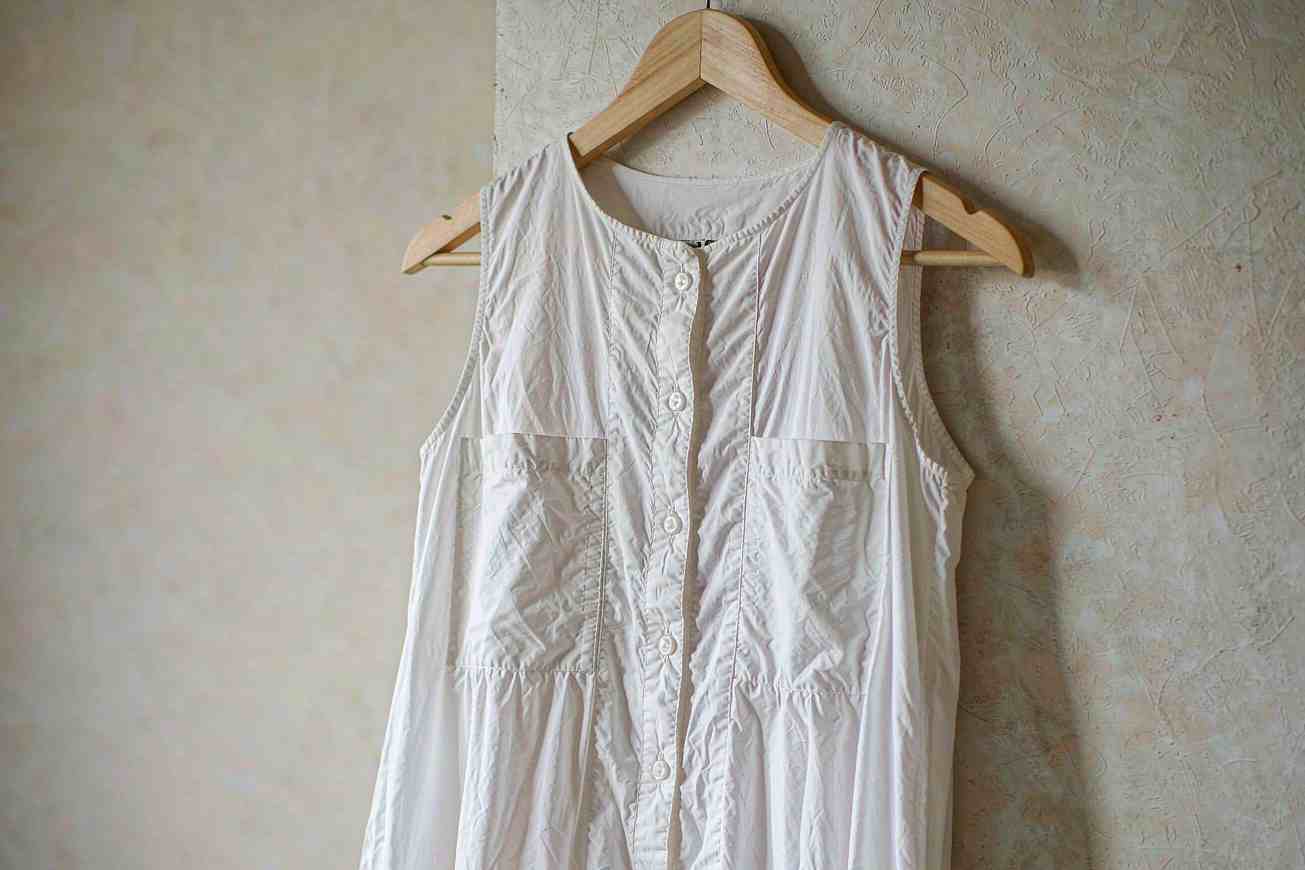
Next are flat-lay images and fabric detail images. These two categories are usually still real photos, so use them as the standard for color difference and texture. Third is content that "moves": static images can be faked, but walking, sitting down, and raising an arm cannot. Prioritize videos of the garment worn and livestream try-ons. Buyer shows in text notes that include height and weight are the most valuable, such as "I am 164 cm tall, and this dress length is very suitable." AI models can never provide this kind of information.
The wording for asking customer service also matters. Don't ask "Is this AI?"—90% of the time you'll get "real shot." Directly ask for two images: a flat-lay real photo and a close-up of the fabric care label.
Platforms Are Clearing the Field Themselves
Zoom out, and the AI image problem isn't only in womenswear. In the past three months, Xiaohongshu has carried out a special campaign against "AI fake seeding," cleaning up nearly 120,000 AI fake seeding notes, banning more than 4,200 accounts, and removing more than 4,000 items per day in the medical aesthetics track. It focused on four high-risk tracks: travel and accommodation, medical aesthetics, education, and real estate.
Xiaohongshu's wording is worth reading closely: it does not oppose using AI to improve efficiency; it opposes mass homogenization and fabricated experiences. Using AI to polish copy, generate supporting images, or make multilingual versions—the platform doesn't care. What is being cracked down on is another playbook: one person, one template, AI mass-generating hundreds of "personally tested and works great" notes, paired with AI-generated usage-scenario images, published nonstop 24 hours a day, where the "experience" in the content is made up.
The four named tracks share common traits: high decision cost, information asymmetry, and users highly dependent on others' experience. Travel and accommodation orders are based on reviews, medical aesthetics on cases, education on results, real estate on experiences. In these four categories, a fake experience note has the highest conversion rate and does the most harm.
The path the platform lays out is: merchants first use real people to prove out an original template, then use AI to scale it. The order cannot be reversed. Only after there is a real experience can there be material to scale; AI is responsible for copying, not fabricating.
This distinction also holds for womenswear e-commerce. Using AI for background replacement, multilingual versions, or extending flat-lay scenarios—these are efficiency gains. Using AI to create a person who has never worn the garment and have her say "personally tested, slimming"—that is something else.
Offline Fitting Rooms Have Actually Become More Valuable
A counterintuitive result is that in this round of controversy, the value of offline stores has rebounded.
For those planning to order during Double 11, there are two more judgment reminders. For heavy silhouette devotees (styles like curved-leg and slight-flare where "one centimeter makes a big difference"), it's best to only order listings that have "actual measurements + real-person try-ons" and save the rest. Bargain hunters should watch out for the reverse trap: the more a discounted item has only one perfect model image and zero buyer shows, the more likely it is a clearance landmine.
The merchant's math is actually clear too. The shooting costs saved will ultimately come back as return costs. The core function of a detail page is only one thing: lowering the consumer's decision cost. No matter how beautifully AI photographs the clothes, if the item doesn't match on arrival, the return rate will give you the answer.
The real challenge for the womenswear industry in this round lies elsewhere. When everyone can press Enter and produce a hundred images, how to make "I know what this garment actually looks like" verifiable again is the question. Anti-removal straps can't solve this problem, and neither can AI models.
Related articles
India Is Writing Its Own AI Safety Rules, and Declining to Copy Washington's
Testing only in English would produce a framework that certifies nothing about most of the deployments it covers.
Tavus Griffin Passed as Human 48 Percent of the Time, and the Company Is Not Shipping It
A pre-recorded fake answers only prepared questions. A real-time system answers whatever it is asked.
Anthropic Found 129,000 Vulnerabilities, Then Tightened the Door
The company at the peak of a security demonstration chose that moment to restrict access further, and the reason is not contradictory.
Six Newspapers Sue Microsoft and OpenAI Over Paywalled Articles in the Training Set
The paywall allegation is the sharpest part: a crawl that reaches past a paywall circumvents the access condition itself.