
Netflix's Eyeline Says Models Get You to 60 Percent. The Rest Is the Job
The most useful sentence to come out of a VFX conference this month was a refusal.
"We're not prompting our way into shots and movies. That's not who we are." That is Mohsen Mousavi, vice president of virtual pioneering at Eyeline Studios, the Netflix-owned effects house, speaking at View Conference in Turin. His credits include the final season of Game of Thrones, so the refusal is not naivety about what generators can do. It is a statement about where the work actually is.
His estimate of that boundary is the interesting part: generative models can get a production roughly 60 to 70 percent of the way. Getting to 100 percent is what matters most.
What "hybrid production" means in practice
Eyeline's method is not "generate the shot." It is a three-way blend: live-action photography, conventional visual effects, and generative tools, with the split decided per shot rather than per project.
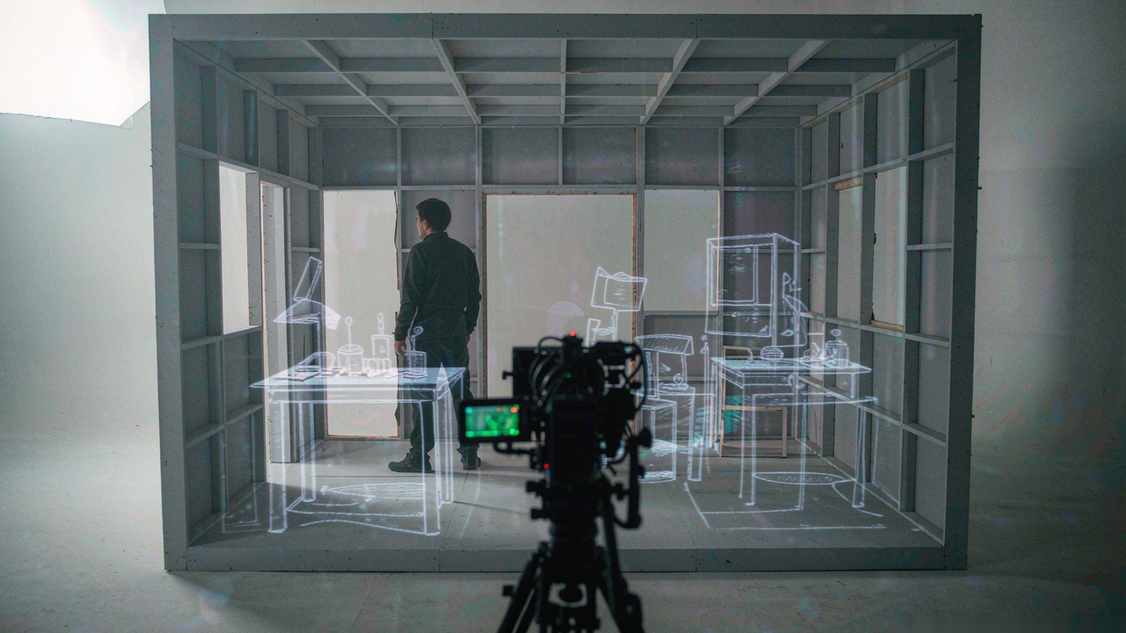
The workflow starts before cameras roll. A generative art department explores designs alongside traditional artists. Then comes the technique that carries most of the weight: sparse sets. Performers act on partial physical sets, lit relatively flat, and the surroundings and lighting get rebuilt afterwards while the original performance stays intact.
Mousavi describes this as an extension of the traditional art department, not a replacement. That framing is doing real work. An art department's job has always been to decide what the camera sees; Eyeline is moving part of that decision later in the schedule.
There is a volumetric capture layer on top. Footage shot in one location can be transformed into another environment, and some of those environments are built without green screens at all. "It gives us both freedom of light and freedom of camera after shooting performances," Mousavi said, with the caveat that the actor's identity and performance have to survive the process.
Two shows, two different problems
For Brazil '70: The Third Star, the drama about the national team's 1970 World Cup win, Eyeline had to fill stadiums with crowds that read as emotionally responsive rather than tiled. The solution was not a single technique: filmed crowd elements, sprites, conventional CG, and generative methods, layered. Mousavi's claim is a budget claim, not an artistic one — doing the same work with traditional VFX "would have been very, very difficult to do within that budget."
For The American Experiment, a five-part historical documentary, the work was quieter: background extensions and generative dust, integrated with practical footage. Dust is a good example of where this technology is genuinely strong. It is volumetric, it is everywhere in a period street scene, it is expensive to simulate convincingly, and nobody in the audience is going to fact-check a particle.
Eyeline also demonstrated changing a performer's apparent age while keeping the underlying acting, and a research short about adjusting camera position and lighting after the shoot. James Rustad, who runs Eyeline's GenFX group, gave a Busan audience the scale on Brazil '70: more than 1,300 VFX shots, 45 artists, and a four-stage workflow — setup, narrative, look, delivery — with a human narrative decision placed deliberately between experimentation and finishing.
The honest part: fluids
Conference talks usually end on the strongest demo. This one included the weakest, on purpose.
Eyeline is working on controllable generative fluids, and Mousavi was direct about the current state: these simulations are not deterministic and very hard to control. The goal is keyframe control over velocity, viscosity, and turbulence, plus the ability to add foam or spray without disturbing the underlying simulation.
Then he said something that only a working VFX supervisor would say: often, in visual effects, what you really want is to break the physics of the fluid. Real water is not dramatic enough. The requirement is not physical accuracy; it is directable inaccuracy. That is a completely different target from what a text-to-video model optimises for, and it explains why the studio is building its own tools rather than prompting someone else's.
Other research shown: restyling a Gaussian-splat 3D capture from winter into autumn, AI-assisted relighting of human performances, and an attempt to build a navigable 4D scene from a single-camera recording. To train the relighting systems, Eyeline uses a rig of 40 synchronised RED V-Raptor cameras, and has also built more portable capture gear.
The trade-off nobody demos: flat light and eyelines
Sparse sets are a clever inversion of a very old constraint. Traditionally, you build the set so the camera has something real to photograph, and you light it to match the story. Eyeline reverses the order: shoot the performance under relatively flat, even light, then rebuild the world around it.
Flat light is the price. It is deliberately uninteresting, because interesting light baked into the plate becomes a problem when you replace the environment — you cannot put a lamp where there was none if the actor's face already has a hard shadow from a window that no longer exists. Shooting flat keeps the performance usable and pushes every lighting decision downstream, where it can be changed.
What you cannot push downstream is the performance itself. Eyeline's framing is consistent on this: the actor's identity and acting must survive. A rebuilt environment does not fix a take where the performer was looking at a tennis ball on a stick and it shows. The technique buys freedom of light and camera, not freedom from directing.
This is also why the studio keeps insisting it is an extension of the art department rather than a replacement. Someone still has to decide what the room looks like before anyone can replace it later.
Why the 60/70 number is the whole story
Think about what the last 30 percent consists of in professional post: temporal consistency across a shot, resolution that survives a 4K finish, high dynamic range, and the ability for a cinematographer to say "darker on the left, and the window should be later in the day" and get that, repeatably, on Thursday.
Generative models are extraordinary at the first 60 percent because the first 60 percent is where novelty lives. They are weak at the last 30 because the last 30 is where consistency lives, and consistency is the opposite of sampling.
This is also why the studio's answer to "which foundation models do you use" was a shrug. Mousavi said most of the work is based on their own research and their own models, with outside partnerships and specially captured training data. Models are the easy part to rent. The capture rig, the training data, and the pipeline that makes a shot repeatable are not.
The part the industry should notice
Netflix said in July that roughly 300 titles had used some generative AI. It has also bought Ben Affleck's filmmaking technology company, InterPositive. Those two facts together describe a strategy that is not about replacing artists: it is about buying the pipeline that lets a fixed number of artists cover more shots.
Mousavi kept returning to a phrase that reads like a procurement requirement: "we want to make sure that it's not a black box." Cinematographers and production designers have to be able to shape the result. If they cannot, the tool does not get used on a show, no matter how good the demo looks.
That is the real dividing line in AI video right now. Not open versus closed, not 4K versus 1080p. It is whether the output can be steered by someone with a specific intention, and whether it can be steered again tomorrow when the director changes their mind. Sixty percent is easy. The last forty is the job.
Related articles
The Three Giveaways of AI-Made Work: Four Pixels Off, an Invisible Stamp, and Nobody's Name
A diagram project's 4px rule, SynthID's invisible stamp and the Nikon scandal, and the publishers using AI without telling authors: three layers of “AI-ness,” only two of which technology can patch.
CLI-Anything Gives Desktop Software a Command Line So Agents Can Use It
Instead of teaching agents to click, HKU's lab generates Click-based CLIs from application source code, with tests, JSON output, and a package you pip install. Real backends, real renders, honest limits.
CLI-Anything Gives Desktop Software a Command Line So Agents Can Use It
Instead of teaching agents to click, HKU's lab generates Click-based CLIs from application source code, with tests, JSON output, and a package you pip install. Real backends, real renders, honest limits.
XERJ Searches Your Code So Agents Stop Reading Whole Files
A Rust search engine with autoindex, tree-sitter symbol awareness, and an Elasticsearch-compatible wire protocol. Its benchmark says 2.7x fewer tokens than grep. Its maintainer says the star count is inflated 13x.