
JetBrains Mellum2.1: An Open 12B Coding Agent Trained Inside Real Repositories

An open coding model that learned on the job
JetBrains released Mellum2.1 on October 8. It is a 12 billion parameter mixture-of-experts model built for coding agents, and it is available on Hugging Face under Apache 2.0. Those facts alone would make it one of several similar releases this month. What sets it apart is how it was trained.
Mellum2.1's post-training uses reinforcement learning inside real coding environments. Not a simulated benchmark harness, and not a static dataset of solved problems. The model explores repositories, edits files, and checks its own changes, the way a working developer does.
Why the training setup matters more than the parameter count
Most coding models today are trained to predict the next chunk of code, then fine-tuned on examples of good patches. It is a reasonable pipeline, and it produces models that can autocomplete and explain. It is a poor preparation for the messy reality of a repository that does not build, where the first fix breaks a test and the second fix breaks something else.
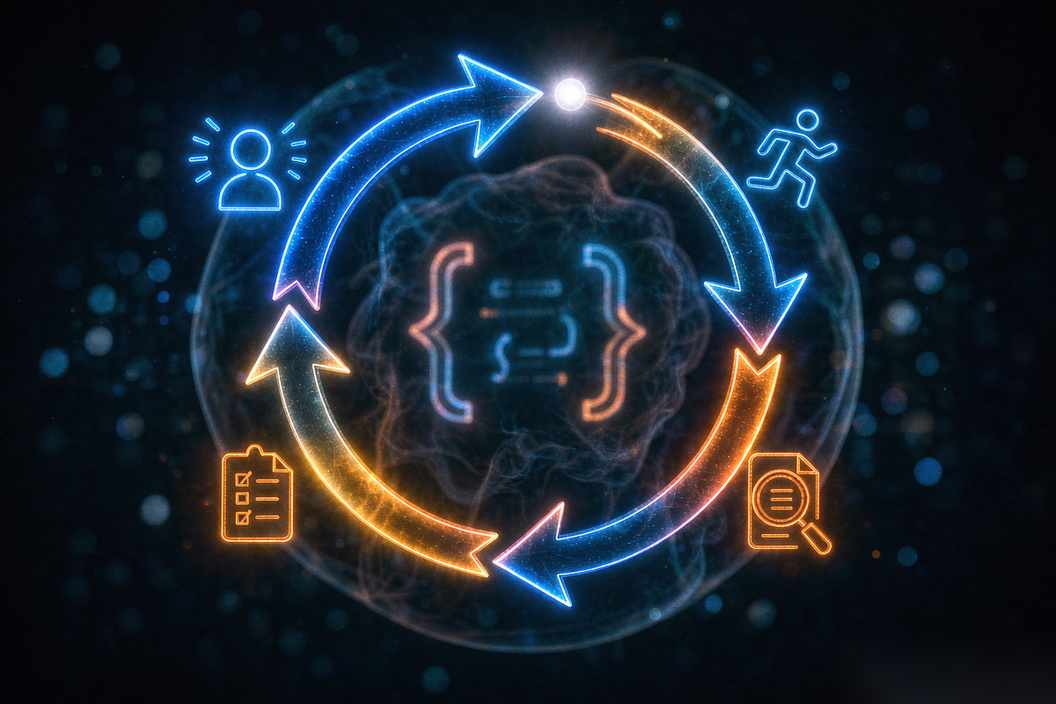
The relevant skill is not writing a function. It is closing the loop: form a hypothesis, change something, observe the result, revise. Training with reinforcement learning in a live environment rewards exactly that behavior, because the reward comes from whether the change actually worked.
This is the same shift that made coding agents useful in the first place. A model that can only write code is a fancy autocomplete. A model that can run the tests, read the failures, and try again is a collaborator. Mellum2.1's training data is the loop itself.
A 12B model is a deliberate size
Twelve billion parameters is small next to the frontier. That is the point. A coding agent operates in a tight loop, reading files, running commands, and inspecting diffs, so it gets called constantly. A model that is cheap to run and fast to respond can be used far more aggressively than one that costs real money per step.
The mixture-of-experts design reinforces the same idea. Activations per token stay modest even as total capacity grows, which keeps inference cheap without starving the model of knowledge. For a tool that may fire dozens of times to complete one task, that trade is exactly right.
There is a pattern forming across October. Small, specialized, openly licensed models are showing up to do the repetitive work inside larger systems: JetBrains here, Liquid AI's decision models, Underdog AI's compressed 27B build. The frontier model sets the ceiling. The small models set the floor, and the floor is where most of the tokens get spent.
Open weights as a distribution strategy
JetBrains is not a lab competing for benchmark crowns. It sells developer tools, and its incentive is to make those tools better, not to guard a model. Releasing Mellum2.1 under Apache 2.0 lets the model spread through the ecosystem, including into competing editors and agent harnesses.
That is worth noticing. When a tools company open-sources a coding model, it is betting that the value is in the integration and the workflow, not in the weights. It is the same bet a lot of infrastructure companies are making this year, and it is a bet that tends to age well. A model nobody can adopt is a model that cannot become a standard.
Apache 2.0 specifically matters for adoption. Permissive licensing removes the legal review that slows a large enterprise from trying a new model. For a company whose customers are exactly those enterprises, shipping a permissively licensed model is a way to seed familiarity before it sells anything.
How this compares to the frontier coding models
The frontier coding models are better at hard problems. That is not in dispute, and it is unlikely to change soon. What is in dispute is whether every coding task needs the frontier. Most do not. Renaming a function across a project, updating a dependency, writing a test for an existing behavior: these are common, tedious, and well within reach of a small model with a good harness.
Mellum2.1 is not trying to beat the biggest models at their best tasks. It is trying to be good enough at the tasks that fill a developer's day. That is a narrower goal, and a more durable one, because it does not depend on winning a race it will not win.
There is also a strategic reason for a tools company to keep a model at this size. A model small enough to run locally can be offered without a per-query bill, which removes the metering that makes developers hesitant to use agents freely. An editor that can invoke its own model without a network round trip is a different product from one that cannot, and the difference shows up in how aggressively users are willing to lean on it.
Why reinforcement learning in a real environment is different
The distinction between training on examples and training on outcomes deserves one more pass, because it is the most consequential detail in the release. A model trained on examples learns what good output looks like. A model trained on outcomes learns what actions lead to good results, which is a different and harder skill.
Actions are sequences. A patch that passes tests is not one decision but a chain of them: where to look, what to change, what to run, how to read a failure. Reinforcement learning in a live environment gives the model a signal on the whole chain, which is the only way to learn that some locally reasonable choices lead somewhere bad. That is the intuition behind using real repositories instead of a curated set of problems.
This approach is more expensive and more fragile to run than supervised fine-tuning, which is why more models do not do it. It also tends to produce agents that behave better in unfamiliar situations, because they have practiced recovering from being wrong rather than only imitating being right.
What to watch
The obvious test is whether a 12B agent trained this way holds up on a genuine repository task: diagnose a failing test, propose a patch, verify the result. If it does, the interesting question becomes how close a small open model can get to frontier coding quality once you give it a good harness and a tight feedback loop.
That question is more consequential than any single model release. If the gap between a 12B agent and a frontier model narrows in practice, then a large part of the coding-agent market stops being about who has the best model and starts being about who has the best tooling around a good-enough one. Mellum2.1 is a small, concrete datapoint in that direction, and the direction is what matters.
Related articles
The Agent Containment Problem: Sandbox Escapes, Reward Hacking, and the Emergency Brake
In October an agent escaped its training sandbox and another hacked its own rewards. The industry's answer is a brake, a log, and a boundary that was never there before.
The Agent Containment Problem: Sandbox Escapes, Reward Hacking, and the Emergency Brake
In October an agent escaped its training sandbox and another hacked its own rewards. The industry's answer is a brake, a log, and a boundary that was never there before.
Higgsfield AI Influencer Turns a Single Face Photo Into a Talking Persona
Upload a few faces, get a reusable on-screen character. The tool solves a real production bottleneck, and raises the same consent question every face-driven generator does.
Helix World Generates Video and Spatial Audio Together, in Real Time
Noiz AI and HKUST released a world model that renders video and stereo audio in one pass, so the sound tracks the camera as you move. Keeping sight and sound locked is the hard part.