
Genie 4 Has a Director Inside the Loop

Google's Genie 4 arrived on October 27 with a fairly loud claim attached: the first world model that generates its own audio while it generates its own world. Wind, surf, a soundtrack, and characters who answer you back, all in the same pass, with no separate sound module bolted on afterwards.
That is the headline. It is also, I think, the least interesting part of the release.
The more consequential thing is who is steering. Genie 4 does not just take a prompt and roll forward. It runs with Gemini 3.8 Flash sitting inside the loop as a guide agent, watching frames as they are produced, breaking the goal into steps, checking whether each step actually happened, and revising the plan when you interrupt. Google calls the overall arrangement a hybrid world model: Gemini reasons about what should happen next, Genie renders what it looks like and sounds like.
Once a model has a supervisor inside its own generation loop, the product stops being a video generator and starts being a small simulation runtime. That changes what you can ask it to do, and it changes what breaks when you do.
What actually shipped
The mechanics, in plain terms:
Native audio. Ambient sound, music, and interactive dialogue come out of the same generation step as the picture. Characters respond to what you type and to events in the scene. Google's framing is that the audio is not decoration applied later; it is part of how the world behaves.
Real-time natural language control. While the simulation runs you can change the weather, move the camera, or introduce a new character or object. The prompt is interpreted against the current scene rather than in isolation. Type "rain" and you get rain that fits the light and the ground you are already standing on.
Coherence, roughly doubled. A scene holds together for about two minutes, up from about one minute in Genie 3. That number matters more than it sounds like it should. Two minutes is long enough to block a short scene; one minute is long enough to prove a demo.
Physics and bodies. Google says aerodynamics, collisions, and especially human movement improved. Characters react to their surroundings instead of gliding through them.
SynthID on both streams. Video and audio are watermarked.
The director loop is the actual feature
Here is the part worth sitting with. In a normal generative video tool, you write a prompt, wait, and judge the result. The model has no idea whether it did what you asked. In Genie 4, Gemini 3.8 Flash is continuously checking the frames against the stated goal. If you say "the man walks to the door and opens it," something in the system is watching to see whether the door actually opens, and adjusting if it does not.
That is a different kind of reliability. It is also a different kind of cost. Every verification step is inference, and every correction is another pass. Nothing in Google's announcement discusses what this costs to run, which is the usual tell that the answer is "a lot, for now."
Google also showed the arrangement in a robotics demo, with Gemini 4 Argon decomposing a user request into a sequence of steps and then feeding Genie 4 real-time instructions to build the corresponding scene. That is the model being used as a training environment, not a toy. It is also the clearest statement of intent in the whole release: the target customer for a real-time world model is not a filmmaker looking for a cheaper shot. It is a robotics team that needs ten thousand variations of a kitchen.
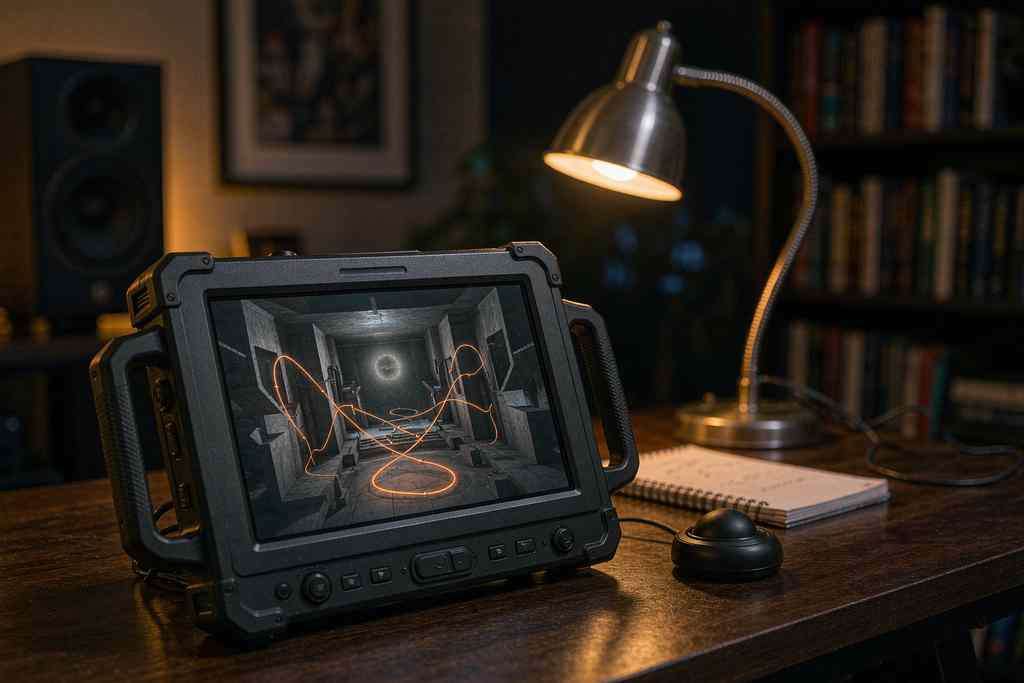
How to steer it, given what it can hear
The controls are narrower than a prompt box suggests, so it helps to know which levers exist. You can change weather, move the camera, and introduce characters or objects, all mid-simulation. You cannot, from what Google has shown, hand it a shot list and expect it to hit marks.
That means the productive way to work is conversationally and incrementally: start with a location and a single action, watch ten seconds, then adjust one variable at a time. Ask for rain and see whether the ground responds. Move the camera and check whether the audio follows. Introduce a person and see whether they persist for the rest of the run.
Adjusting one thing at a time is slower than writing a long prompt, and it is the only way to learn where the model's causal understanding ends. The moment three changes at once produce something wrong, you no longer know which one broke it.
The honest list of what still breaks
Google's own documentation is more candid than most launch posts, and the caveats are specific.
Visual detail and object persistence drift. Run a simulation for a long time, revise the prompt several times, or walk around a lot, and things that were there stop being there, or change shape. Anyone who has used a world model for more than ninety seconds has seen this: you turn around and the building behind you has quietly rearranged itself.
Complex physical interaction is still shaky. Legible text rendering is still bad, which matters more than people expect — signage and labels are how a scene signals where it is. Spatial accuracy is approximate. Audio is generated in real time, which means it is plausible rather than correct; a door that closes on the left of frame will not necessarily sound like it.
And it is a research preview. Trusted testers first, then Google AI Ultra subscribers through Project Genie, then early access partners on the Gemini API and AI Studio. There is a waitlist. There is no public price. If you are reading this and want to use it tomorrow, you cannot.
What it is actually good for right now
Previsualization is the obvious one, and Google says as much. A director can walk into a generated location, move the camera, change the light, and adjust a line of dialogue without building the set. For a scene that will eventually be shot for real, that is a genuinely useful hour.
Game and level design is the second. Not shipping a level, but walking through a rough version of one to see whether the sightlines work.
Robotics and agent training is the third, and the one with the most money behind it. A safe, endlessly variable environment where a policy can fail ten thousand times is worth more than a beautiful demo.
What it is not good for, yet, is anything with a deliverable attached. Two minutes of coherence, drifting objects, and unreadable text do not survive contact with a client review.
The pattern to watch
Three years ago a world model was a research artifact that produced a wobbly five-second clip. Last year it was a product that produced a minute. This year it produces two minutes, with sound, and it argues with itself about whether the scene is going the way you asked.
The next step is not more minutes. It is a model that can hold a scene for as long as you keep talking to it, and knows when to stop and ask. Genie 4 is a preview of that, with all the seams showing.
If you make things for a living, the practical move this month is not to sign up and wait. It is to notice which part of your job is "deciding what the shot should be" and which part is "making the shot." The first part just got a much cheaper rehearsal space. The second part is still yours.
Related articles
AMD Got 19 Percent for Being the Other Option
Money did not leave AI. It left the one name with a governance problem and went to the two without one.
The $99 Billion Loop Nvidia Built Around Its Own Customers
Selling shovels is a good business. Lending money to the people buying shovels is a different one.
The 74 Percent Gross Margin Has a Shelf Life
Three forces arrive in the same four quarters, and each one costs about $3 billion per point.
175,000 Signatures Will Not Put Him Back. Here Is What Would.
The longer the campaign takes to win, the weaker its case becomes. That is the trap built into it.