
An App Drew 11,064 Bird Species With AI. Birders Checked the Eyebrow First
In the first days of November, a set of illustrations set the birding world on fire.
A bird-logging app announced that it had used AI to produce “portrait stickers” for all 11,064 bird species on earth: more than a thousand species, more than a thousand images. Framed that way, it sounded like a single fix for a problem that has never gone away. Anyone who works on bird identification or science communication knows the gap: a large share of the world’s species exist in the record only as specimen photographs, hand-painted plates, or film shot decades ago, and the general public has never seen them. Someone wanting to fill that hole is, on the face of it, a reasonable thing.
The backlash came fast. A long-time birder and writer published his view in The Paper, and the anger was not mainly about “you used AI.” It was about what he spotted by eye in the company’s own Xiaohongshu advertisement: the yellow-eyed penguin’s eyebrow was wrong. In penguins, the markings above the eye are one of the key characters used to classify the group. Getting them wrong is not an aesthetic complaint. It is an identification failure.
The images were drawn by AI and checked by AI
What birders actually care about is that nobody looked at these images at any point between production and sign-off.
Differences between species often come down to a few percentage points: the length of a supercilium, how much of the primaries shows past the tertials, the curvature of the bill, the colour of the tarsus. These are precisely the places where generative models smear, because most of the “birds” in training data are well-composed photographs rather than specimen plates with measurement annotations. The model learns “this looks like a bird,” not “this is a specific finch.”
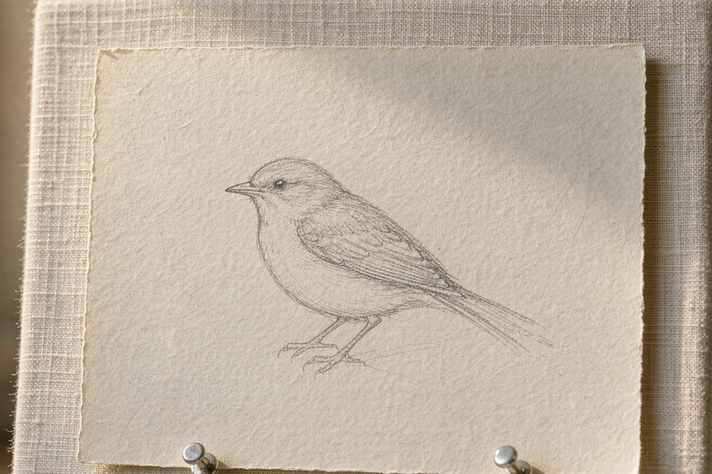
Put images like that into identification tools and teaching material and the damage is not that they look bad. It is that the error gets fixed as a reference. Users compare against it and drift further off with every comparison. Beginners memorise the wrong picture first and then have to spend far more effort unlearning it. The writer’s term was “data contamination,” which is accurate.
There is another layer: the images were generated by AI and reviewed by AI. Using a model to check a model’s output means the same bias signs its own work. Doing this properly requires at least a manual spot check, with the error-prone groups pulled out and reviewed separately.
Training on images and redrawing them are two different acts
The second objection is about copyright.
The writer says the set scraped a substantial number of photographs to use as templates. Training a model on scraped images is one thing; taking those images without permission to redraw from them is another. The first sits in a grey zone in most jurisdictions. The second is much easier to characterise as copying. If the redraw leans heavily on the original and the output closely resembles it, the result is closer to “a copy with edits” than to “an independent work.” The project also has commercial ambitions, and open-sourcing the code does not change what it is.
The line is not complicated. A model learning from millions of images what a bird looks like, and a model staring at one specific photograph and reproducing its composition, pose and light, are two different behaviours. The first is learning. The second is tracing. The difference is whether there is a specific, identifiable original in the loop.
One practical suggestion
The writer’s advice is more worth copying than his criticism: if you insist on drawing birds with AI, change to a style that is not realistic.
That one sentence solves most of the problem. Illustration, printmaking, flat colour collage, minimal silhouette — a viewer can tell at a glance that this is not a photograph and will not use it as identification evidence. Data contamination depends on the image being mistaken for real. Once the style declares itself as a diagram, that precondition is gone. Realism is still an option, but then somebody has to check 11,064 images one at a time, and the cost is yours to calculate.
He also put one point politely: software and natural history are two entirely separate worlds. Entering another world without following its rules, while claiming to serve it, burns.
The same week, Xiaohongshu went after another kind of “looks real”
If the bird story is AI image generation hitting a requirement for accuracy, this round of Xiaohongshu enforcement is AI hitting a requirement for authenticity.
Around November 5, Xiaohongshu began a targeted content sweep, with AI impersonation of public figures for product sales as the focus. Two categories are in scope. The first is face swapping: a public figure’s face composited into a sales video so viewers believe the person is recommending the product. The second is AI voice cloning: a public figure’s voice replicated and laid over pre-cut footage reading promotional copy.
Penalties land on both posts and accounts. Offending posts are taken down and stop being distributed. Accounts that repeat the behaviour get reach limits and restrictions on commercial permissions, with bans in serious cases. Deliberately imitating a public figure’s features, or generating an AI likeness to sell with, is also part of the review.
The logic runs parallel to the bird story. A consumer sees a face, hears a voice, and decides on the basis of “I know this person and I trust what they say.” AI makes that chain very smooth — smooth enough that no step in it requires anything real. When the product turns out to be defective, the buyer discovers the person was never involved in the promotion, and by then it is no longer clear who to pursue.
Both are patching the same hole
Put the two stories side by side and they are filling the same gap.
Bird guides lack images because the birds are hard to photograph, expensive to license, or impossible to clear. Sales videos lack a presenter because the presenter cannot be booked, costs too much, or has no slot in the schedule. AI is very good in both positions: the cost is near zero and the timeline is hours instead of months. The problem is that the two gaps are not the same kind of gap. One is short of an illustration. The other is short of an endorsement.
Illustration can come from AI, as long as it is labelled as illustration. Endorsement cannot, because its entire value rests on the fact that the person actually thinks this. Handing the second to a model removes the premise of the whole transaction.
China’s rules on labelling generated content have been in force since October 1, requiring both visible labels and embedded metadata. How well that lands depends heavily on whether platforms are willing to choose between traffic and compliance. Xiaohongshu’s sweep offers a sample: move the traffic first, discuss labelling after. A label is something you can check afterwards. A reach limit hurts beforehand.
Three plain statements for people who make content
First, for datasets, illustrated guides and teaching material, AI is fine for first drafts and placeholders, not for final copy. If it is going out in public, the cost of human review belongs in the budget and does not get cut.
Second, style is itself a claim. Realism promises “this is true.” Illustration declares “this is drawn.” Either is fine. Do not pick wrong and then blame the audience for misreading it.
Third, where a real person’s face and voice are involved, there is no shortcut on permission. What Xiaohongshu did shows platforms are now acting on behalf of the people being impersonated. Waiting for someone else to file a complaint costs far more than clearing rights in advance.
The yellow-eyed penguin with the wrong eyebrow ended up as an expensive reminder. A model can produce a hundred thousand images that look like birds. It does not know which one can be used to teach someone how to identify a bird.
Related articles
Chinese text in video always turns to mush. Dreamina handed the typesetting to code
Dreamina launched Motion Studio on November 10. It no longer generates frames; the model writes code that lays out text, shapes and pacing. Chinese titles stop blurring, but whether the content is right is still on you.
A community spreadsheet of taps that turns off the ads inside Chinese Android builds
A no-root tool that switches off the ads Chinese phone makers ship inside the system UI. Its method is a hand-written tap script per phone model, maintained by volunteers every time a ROM moves. It works, and the maintenance is the point.
GPT Image 2.6 held the token price and raised the bill
GPT Image 2.6 kept every token rate from 2.5 and still costs more per image, because more of the work now happens in output tokens. Eleven days into the ramp, the pricing structure says more than the leaderboard does.
Someone rebuilt IDM from the outside and wrote down what they did not touch
A Rust reimplementation of Internet Download Manager claims 5x the speed and 86 languages. The more interesting document is the paragraph explaining how it was built without copying anything.