
A Wheeled Semi-Humanoid Finished an Hour of Laundry Without Help
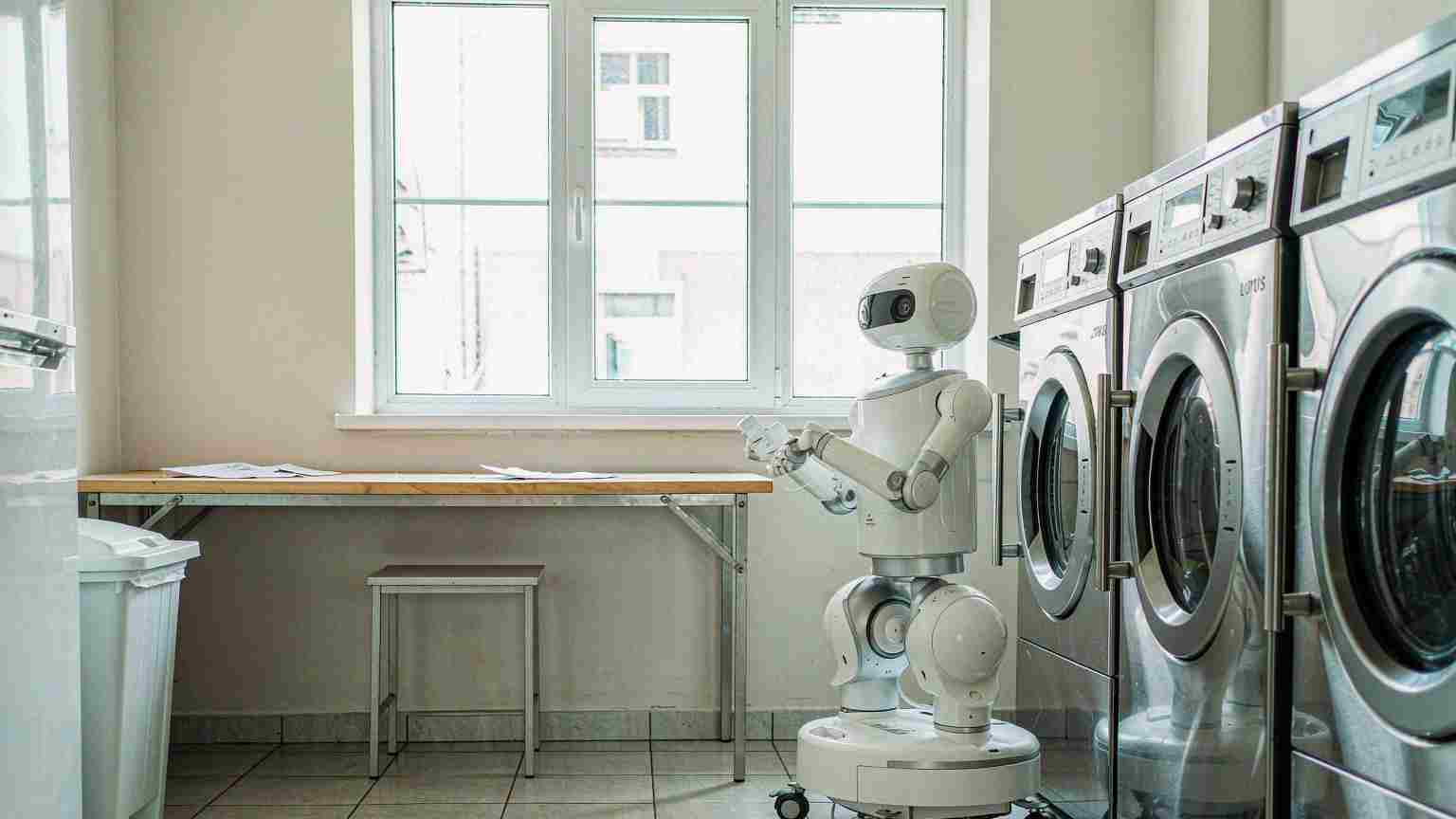
Dyna Robotics has released a new robot and the system that drives it, and the demonstration is deliberately unglamorous: an hour of hotel laundry, filmed in one continuous take.
The robot is called Taku, from the Japanese word takumi, meaning master craftsman. It pairs a human-shaped upper body and two seven-degree-of-freedom arms with a folding lower section, all mounted on four steerable wheels. The software is Dyna-2.1, which the company calls a physical agent, built for whole workflows rather than single manipulation tasks.
In the video, Taku moves between washers, dryers, a folding table and shelving. It loads and starts machines, unloads them, retrieves towels, folds and sorts them, and stacks the results. When a grasp fails, or it picks up two towels at once, or it gets pulled off a machine control, it recovers without asking a person for help. Dyna estimates one laundry cycle spans about 79 distinct steps.
Three layers underneath
The architecture splits the job into three parts, and the division is the interesting engineering.
At the top, a vision-language orchestrator watches the workflow, keeps a text-based memory of what has happened, and decides what to do next. In the middle, an improved version of Dyna's world-action model generates whole-body movement targets. At the bottom, a whole-body controller, trained with reinforcement learning across thousands of simulated robots in NVIDIA's Isaac Sim, converts those targets into joint and wheel commands at 100 hertz.
That layering matters because it separates deciding from doing. The orchestrator reasons about the task in language, which is flexible and easy to change. The controller handles the low-level physical reality at a speed no reasoning model could match. Neither has to be good at the other's job.
One million hours of video
The training data is the part that explains the ambition. Dyna says it pretrained the policy on one million hours of human and robot data, drawn from human video and its own robot fleet, described through a shared representation that expresses human and robot motion in the same format. The dataset is reported as 43 million episodes, stored in containers that made storage far smaller and sample reads several times faster than a naive per-frame approach.
Using human video as the bulk of the training signal is the bet that general physical competence can be learned by watching, not just by doing. A robot fleet alone would take far too long to accumulate a million hours of varied real-world experience. Human video is abundant, and the shared representation is what lets the model transfer the patterns it sees in people to a machine with a different body.
Dyna also chose wheels over legs, and the reasoning is refreshingly practical. The workflows it targets require moving between workstations and reaching into machines, at a table, down to low shelves and up above the head. Humanlike walking is not on the list. Legs would add cost and complexity for a capability the job does not need.
The metric that changed
The most telling detail in the release is what Dyna decided to measure. Instead of reporting success rates on individual tasks, the company optimized mean time between interventions, the span a robot runs before a human has to step in.
That is a harder and more honest target. Individual tasks can have high success rates while a workflow still fails, because failures accumulate when you chain many steps together. A robot that succeeds at 95 percent of its grasps will, across 79 steps, run into trouble quickly. MTBI measures the thing an operator actually cares about, which is how long the machine can be left alone.
The target customer is not a research lab. Dyna runs a robots-as-a-service model, charging a monthly fee per robot that bundles hardware, software, maintenance and model updates. That turns a large capital expense into an operating one, which matters for the small businesses the company is courting. It also gives Dyna a continuous stream of training data from real deployments. The founders have stressed that the hardware is deliberately cheap, tens of thousands of dollars rather than hundreds of thousands.
Why laundry is a sensible place to start
Choosing laundry as the flagship demo is smarter than it looks. Hotel laundry is repetitive, high volume, and unpleasant enough that labor turnover is a real cost. It also happens in a fixed room, with cooperative machines, a bounded set of objects and a predictable sequence. That is a much friendlier environment than, say, a cluttered kitchen or a public street.
The narrowness is the point. A robot that can reliably do one tedious thing in one controlled setting is far more valuable today than a generalist that fails unpredictably everywhere. If laundry works, the same architecture can be pointed at other bounded workflows with similar properties: dishwashing, linen handling, simple warehouse sorting. Each one is a business on its own, and each one feeds the same data engine.
Where the claim ends and the reality begins
The demonstration is a company video, not an independent evaluation, and the deployment claims deserve a careful read. The press release says Dyna-2.1 is being deployed in hotels, laundromats and restaurants. The more detailed research post frames bringing the system to real customer sites as the next milestone. No customer running Taku has been named publicly, and no intervention data from a commercial deployment has been released.
That gap between a launch release and a technical report is common in robotics, and it is where the truth usually lives. A one-hour uncut video is a real accomplishment. It is also a curated environment, and hotel laundry is a friendlier setting than most.
Dyna previously deployed robots for narrower work, including a napkin-folding rollout with the restaurant chain Din Tai Fung, and raised $120 million in 2025 with backing that included NVIDIA's venture arm and Amazon's industrial innovation fund. The company's next milestone, by its own account, is taking the new system into customer sites and using what happens there to improve it.
Why this one is worth watching
Robotics demos are easy to make and hard to trust. What separates a serious system from a polished video is usually unglamorous: how gracefully it fails, how rarely it needs help, and whether the economics work at the customer's site rather than in the lab.
Dyna's choice to measure mean time between interventions, its use of human video at scale, and its decision to build a cheap wheeled body for real jobs are all signs of a team optimizing for deployment rather than for a demo reel. None of that confirms the claims. It does suggest the company knows what the hard part is.
A robot that can finish your errands is still far away. A robot that can run one specific, tedious, multi-step workflow for an hour without supervision is a much smaller claim, and if Taku can do it reliably at a customer's site, it is a meaningful one. The laundry room is a test. The interesting question is what happens when it leaves it.
Related articles
Agility Digit 5 Ships With a Safety Case, Not Just a Spec Sheet
A warehouse floor is not a lab. Certification is the gate, not the demo.
Frontier Agents Finished 30 Percent of a Research Workflow. That Is the Number.
Agents can run research. Inventing the procedure is still out of reach.
Figure AI Locked In $3.5 Billion of Compute Before It Has a Product to Sell
The bet is that generalisation is a compute problem. The field has not settled that.
OpenAI Finally Put Transparent Backgrounds in the Image API
A small feature that deletes a whole step from the pipeline.