
A Fan Remade a 1983 Wuxia Classic With AI. Viewers Said It Beat the Remake.
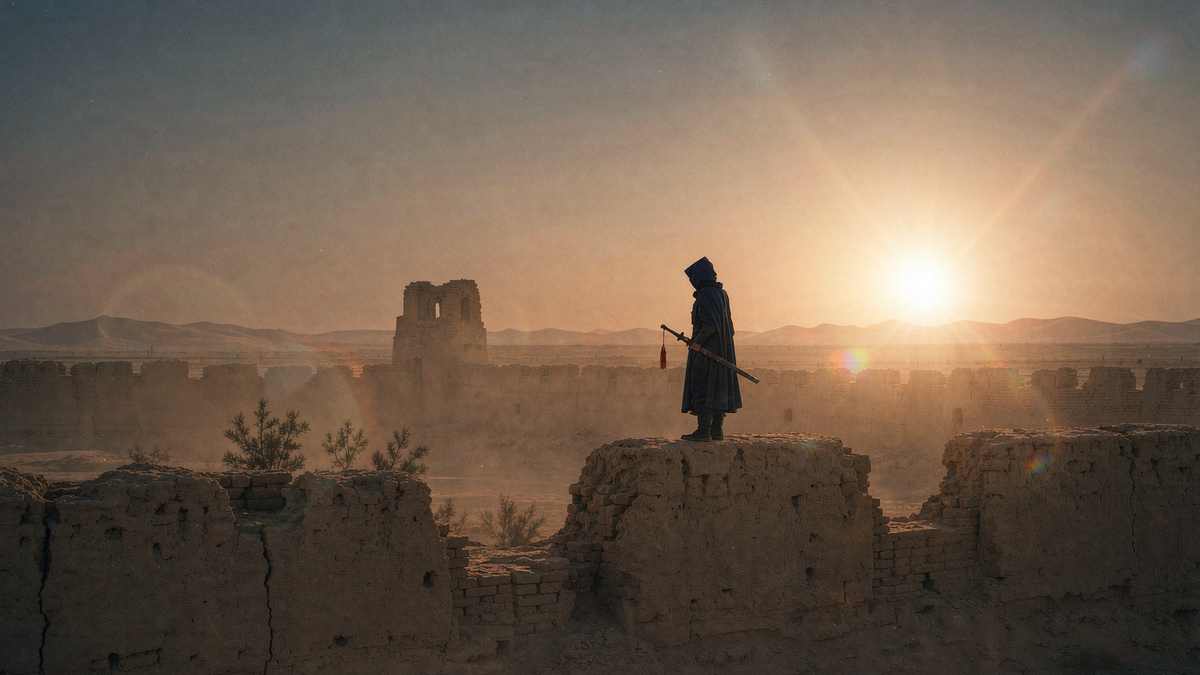
Around October 16, a clip started circulating on Chinese social platforms that claimed to be a remake of the 1983 television adaptation of The Legend of the Condor Heroes. The desert, the ruined fortress, the fur-trimmed costumes, the snow — all of it was generated. The topic that formed around it on Weibo was blunt: "the AI Condor Heroes looks better than the live-action one."
That phrasing is doing a lot of work. It isn't a claim that AI can act. It's a claim that AI can out-produce a category of television that viewers already consider lazy.
What the clips actually are
They are not feature-length. Most are short sequences — a duel on a wall, a ride across a plain, a reunion in a tavern — assembled shot by shot with current image and video models, then cut together with generated or cloned dialogue. The most-cited example on Bilibili is a fan-made sequel to an obscure wuxia story: one person, one month, one episode, 450,000 plays. A second creator's version passed 330,000.
Chinese entertainment outlets noted three things that landed well: the costumes and props, the set construction, and the voice work. One reviewer argued that the dubbed Huang Rong sounded more natural than in some of the officially licensed remakes. That last point stings, because it suggests the bar being cleared isn't technical excellence — it's basic competence.
The part AI is genuinely good at
Wuxia is an unusually favorable genre for generated video, and it's worth being precise about why.
First, the visual grammar is already highly stylized. Floating on a rooftop, sword qi shattering a stone lantern, a fight in falling snow — these are established visual conventions, not documentary observations. A model trained on decades of wuxia footage has an enormous amount of consistent reference material, and the audience has been trained to accept the artificiality.
Second, wuxia depends on landscape in a way that most drama doesn't. The genre's emotional register comes from scale: a lone figure against the Gobi, a sect's gatehouse in fog. Real productions either pay for a location shoot or build a set. Generated video gets the Gobi for free, and gets it in the exact composition the shot needs.
Third, the economics invert. A live-action wuxia series is a 30-to-60-million-yuan bet with a two-year lead time. A generated episode is one person, one GPU account, and thirty days. That's not a cheaper version of the same product; it's a different production model, closer to fan fiction than to television.
The part it's bad at, which is the part that matters
The criticisms are consistent and, in my view, correct. Faces converge. Not literally identical, but drawn from the same narrow distribution of "attractive Chinese face, mid-20s, symmetrical" — the visual equivalent of everyone having the same font. A cast of eight reads as a cast of two.
And performance doesn't survive. Acting is micro-timing: the half-beat before a line, the breath that changes mid-sentence, the decision to look away. Current video models generate plausible motion, not decisions. You can get a beautiful close-up of someone receiving bad news and it will look like a person receiving bad news. It won't look like this person, in this scene, deciding to hide it.
There's a structural reason for that. Models are trained to produce the most probable next frames given a prompt. Acting is the deliberate selection of an improbable response. The two objectives are in direct tension, and no amount of resolution fixes it.
Why "better than the remake" is still a real signal
It would be easy to dismiss the Weibo take as novelty-seeking. But the comparison being made is specific, and it's about a real pattern in Chinese streaming: remakes of beloved classics that are shot cheaply, cast for traffic rather than fit, and lit like a commercial.
Against that baseline, a generated episode that carefully reproduces the 1983 color palette and the original costume silhouettes can genuinely look more respectful of the source than a licensed remake that ignores it. The AI isn't better at filmmaking. It's better at fidelity, because fidelity is a matter of reference images, and a fan has thousands.
That's the uncomfortable finding for studios. The moat around adaptation was never technology. It was taste, labor, and rights. Two of those three are now cheap.
The rights question nobody in the clips addresses
Everything above happens in a legal gray zone that is getting less gray by the month.
In September, China's National Radio and Television Administration ran a campaign against "AI-modified" video, targeting unauthorized reworking of the four great classical novels, historical subjects, and films about national heroes. Major platforms took down close to 13,000 videos in September alone. The stated concern is distortion of classic works and infringement of performer likeness.
So the same window that produced the Condor Heroes clips also produced a sweeping takedown. That's not a contradiction; it's the normal pattern. Enforcement targets distribution at scale, not individual fan works. A creator with 450,000 plays on Bilibili is visible but small. A creator with a hundred uploads across five platforms and a merch link is a target.
For anyone thinking of trying this: the practical risk isn't the model vendor. It's the underlying novel, which in Jin Yong's case is still under copyright, and the performers whose faces the model has learned. Chinese courts have been steadily expanding likeness protection, including a Mumbai-style ruling pattern where "identifiability" rather than literal copying is the test.
What this predicts
Three things seem likely from here.
One, fan-generated sequels and side stories will grow faster than fan remakes, because original characters avoid both the copyright and the comparison problem. The 450,000-play example was a sequel to an obscure story, not a remake of a famous one. That's not an accident.
Two, the professional floor will move. If a solo creator can produce a watchable episode in a month, the budget conversation for mid-tier genre drama changes. Not for prestige productions — those sell on the presence of specific actors — but for the enormous middle layer of streaming content that exists to fill a schedule.
Three, the "AI look" will become a genre marker, the way black-and-white or handheld camera became markers. Audiences will learn to read it in about eighteen months, and then some directors will use it deliberately and some will spend money to avoid it.
The Condor Heroes clips are not the future of television. They're a proof of concept for something narrower and more interesting: that the visual texture of a beloved classic is now a downloadable asset, and that the people who care most about that texture are not the ones who own it.
Related articles
The Video Leaderboard's Number One Is a Talking Head
HeyGen Video leads at 64,000 weekly requests, ahead of Veo and Wan. Chinese labs hold about 54.8% of routed video traffic while Runway sits at 0.3%. What request volume measures.
VideoGen Promises Ten-Minute Videos From One Prompt. Nobody Benchmarked It.
Ten minutes is assembled from many shots, not rendered in one pass. The product is the planning harness, and the cost and quality claims are still waiting on third-party validation.
NVIDIA's OpenShell Enforces Agent Policy in the Kernel
Kernel level checks on every file, syscall and connection, plus formal verification of policy changes before they apply. The install is one line. The operational bill is the rest of the page.
FLUX 3 Max Renders 10 Seconds of Video in 11. The Benchmark Has an Asterisk.
Fal post-trained FLUX 3 for speed and got a 1139 Elo claim out of it. The vote count is preliminary, the confidence interval overlaps the leader, and the 75% discount runs three weeks.